

frailty syndrome
Frailty syndrome assessment: how camera-based monitoring fits clinical care
What decision should a care organisation make?
The decision is not whether a camera should replace established assessment; it is whether an additional way to capture and follow mobility-related information fits your care setting.
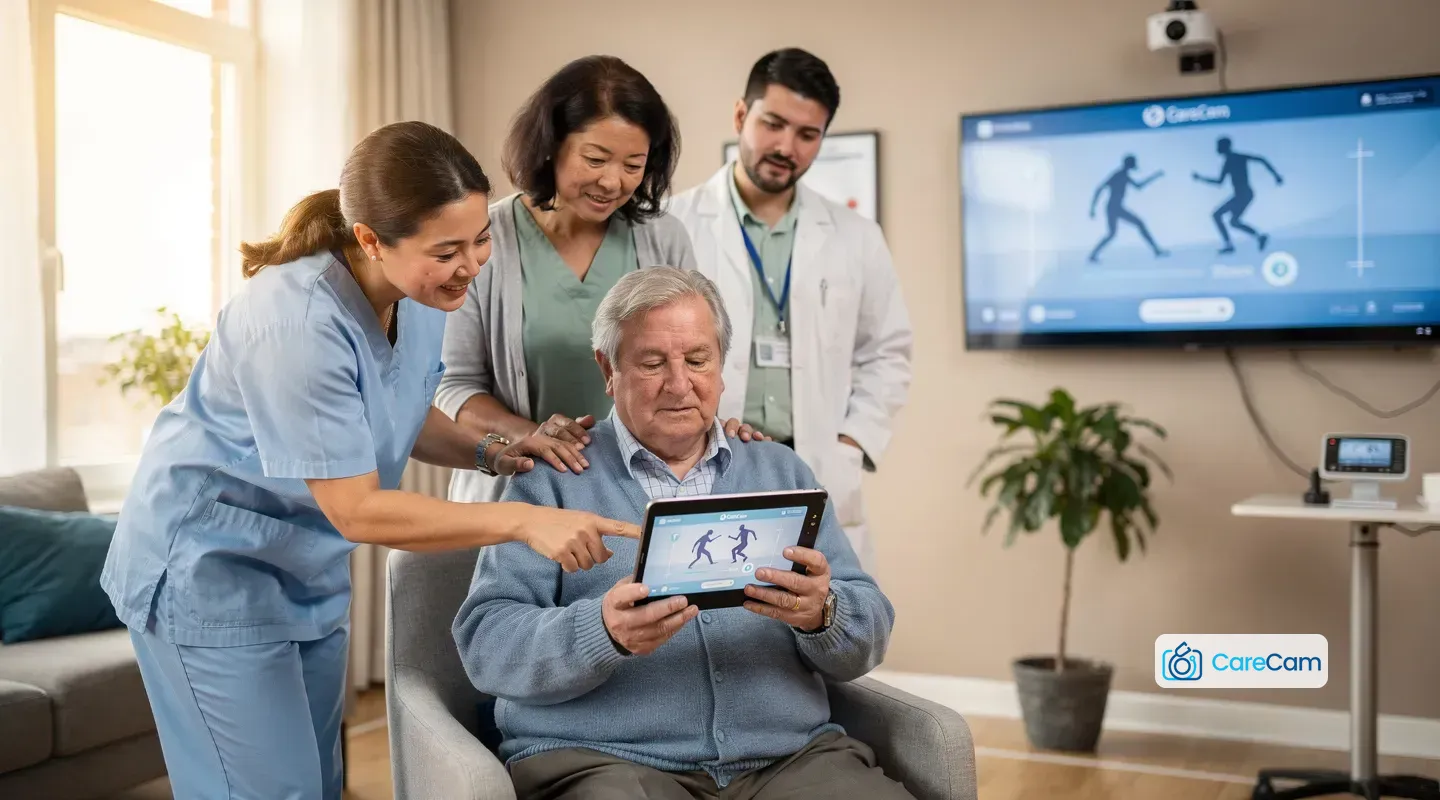
Our assessment uses questionnaires and physical tests carried out by trained care teams. It can also involve capturing a short video, analysing it, reviewing the results, and tracking changes over time. That combination gives your team a practical starting point for discussing what you need to measure, how often you need to review it, and where the information belongs in care planning.
A useful decision has three parts:
- Clinical purpose: Decide whether you need information for a pre-operative assessment, post-operative recovery, fall risk assessment, neurological rehabilitation, orthopaedic care, or another defined pathway.
- Measurement need: Decide whether mobility, strength, balance, fall risk, or change over time is difficult to capture consistently with your existing process.
- Review boundary: Decide who will interpret the information and how it will sit with your existing clinical assessment.
We support assessment before and after surgery for hospitals. That support may make a discussion useful when your organisation needs to track movement-related change over time. They do not remove the need for professional review.
What is frailty syndrome?
Frailty syndrome is a state of increased vulnerability across multiple health domains, with reduced physiological reserve and a reduced ability to cope with acute stress. It is broader than a single symptom such as slow walking, weakness, or a recent fall. Frailty may be associated with falls, disability, hospitalisation, and death, but those outcomes do not by themselves establish a frailty classification.
Frailty is generally age-related, but it is not simply the same as normal ageing. The presentation can be variable, so it may be overlooked or mistaken for ordinary age-related change. It can involve physical, cognitive, and psychosocial dimensions rather than physical decline alone.
For your service, this distinction matters. A movement measure may reveal information about gait, balance, or strength, while a wider assessment may also need to consider cognition, mood, function, nutrition, disease, and the person’s wider circumstances.
Two common models show why different assessment tools can produce different kinds of information. One model considers unintentional weight loss, reduced muscle strength, slower gait, exhaustion, and low energy expenditure; three or more characteristics generally indicate frailty in that model, while fewer may indicate prefrailty. Another model views frailty as an accumulation of deficits that can include symptoms, diseases, and cognitive decline.
No single definition has been widely accepted and incorporated into clinical practice. Your organisation therefore needs to identify which assessment model, tool, and clinical purpose it is using before it compares results across services or over time.
Why does the definition matter in practice?
The definition matters because it affects what your team measures and what decisions the information can support. A narrow movement check may help describe mobility or balance, while a broader frailty assessment may include physical, cognitive, psychosocial, nutritional, and functional factors.
In a Singapore qualitative study, providers described frailty screening as a way to identify patients at higher risk of adverse outcomes and inform decision-making and prognosis estimation. The British Geriatrics Society says pre-operative comprehensive geriatric assessment should be considered for some surgical patients with multimorbidity, cognitive impairment, functional dependency, or uncertainty about whether surgery should proceed.
That distinction is especially relevant around surgery. A pre-operative assessment can establish a reference point before an operation, while post-operative recovery may require a later review of mobility and function. The British Geriatrics Society says that identifying moderate or severe frailty should prompt shared decision-making, advance care planning, and proactive rehabilitation and discharge arrangements.
We offer a baseline assessment before surgery and support assessment before and after surgery for hospitals. A baseline can help your team organise later observations around a known starting point, but it does not by itself determine whether surgery, rehabilitation, or discharge is suitable.
A Singapore study also reported that frailty may require modified treatment or more intensive clinical care. That does not turn a screening result into a treatment plan. It means your organisation should decide in advance who reviews the result, which wider information is considered with it, and how any resulting care discussion is recorded.
Which assessment approaches are already used?
Frailty is commonly assessed through a combination of questions, clinical history, physical tests, and broader review. A comprehensive geriatric assessment can identify signs and risk factors that suggest frailty, while validated tools may classify a person as not frail, prefrail, or frail. The choice of tool should follow your clinical purpose rather than the availability of a particular score.
We commonly assess frailty using questionnaires and physical tests carried out by trained care teams. This gives your organisation a familiar clinical starting point and makes it possible to discuss where additional movement information could fit.
Your existing approach may draw on different kinds of information:
- Questionnaires and history: These can cover symptoms, activity, function, and other health factors.
- Physical tests: These can examine strength, gait, balance, mobility, and functional ability.
- Comprehensive review: This can bring together multiple health domains rather than treating a single movement finding as the whole assessment.
- Timed or structured tests: These can provide a defined task or time point for comparison, with interpretation by the care team.
That breadth shows why a movement measure should be positioned as one part of a wider assessment when the clinical question concerns frailty or falls.
Our described camera workflow adds a short video capture, analysis, results review, and progress tracking to the assessment process. It does not change the need for your trained team to select the right assessment approach or interpret the information within the person’s wider clinical context.
What should organisations make of screening guidance?
You should treat screening guidance as a question about purpose, population, and local workflow rather than as a universal instruction to screen everyone. The cited American Family Physician review states that there is no current recommendation for routine frailty screening. By contrast, providers in a Singapore qualitative study said frailty screening can help identify patients at higher risk of adverse outcomes and inform decision-making and prognosis estimation.
These statements address different kinds of information: one is a clinical review’s position on routine screening, while the other reports how Singapore providers viewed the practical value of screening. Your organisation should define the group being assessed, the decision the result will inform, and the clinical response available after identification. That last question is the operational test. Screening has value only when a result leads to an appropriate next review; without a defined response, a further measure may add information without changing care planning. For a Singapore service, compare the intended use with the guidance and governance that apply to your setting rather than importing a routine-screening position from another jurisdiction. Document whether the process is exploratory screening, a fuller assessment, or monitoring within an existing pathway. This also helps staff explain why the result is being collected and prevents a screening output from being treated as a diagnosis.
Falls guidance adds another useful boundary. NICE recommends comprehensive falls assessment and management in hospital inpatient and residential care settings for people who meet its assessment criteria.
A fall risk assessment therefore should not be reduced to a camera score or a timed movement task. If your organisation explores our assessment, define how its mobility, strength, balance, and fall-risk information will sit alongside the broader falls process.
Our assessment generates a frailty report that highlights individuals at higher risk and areas to focus on for care. That report can support a defined review process, but your organisation still needs to set the screening threshold, assign clinical responsibility, and decide what action follows the review.
Use the report as a prompt for that review, not as a standalone classification of the person. The reviewer can place its findings beside questionnaire responses, physical tests, and wider clinical information already used by the service. This keeps the screening purpose clear: identify who may need closer assessment or discussion, then let the care team decide what the combined information means.
What do mobility, strength, balance, and fall-risk measures add?
These measures can be reviewed alongside the wider frailty assessment. A clinical question may focus attention on slower movement, reduced strength, or impaired balance. Review the findings with other relevant information.
NICE also includes gait, balance, mobility, and muscle strength in its comprehensive falls assessment. The overlap makes these measures relevant to care planning, but it does not mean that the measures are interchangeable with a complete falls or geriatric assessment. Taken together, these measures can help a team separate a broad movement concern into areas for review instead of collapsing every finding into one label. That distinction is useful when a pathway has a specific question: for example, whether the review should focus on mobility change, balance, strength, or fall-risk discussion. Agree the priority before assessment, then decide which wider information will be read beside the selected measure. This makes the output easier to connect to an existing care meeting without treating it as a complete frailty assessment.
Traditional fall-risk assessment combines screening questions with timed tests, and the results can vary between assessors. That variation is a practical reason to examine how your team records movement information and compares observations across visits. It is not proof that a camera-based method is more accurate or that it should replace the assessor.
For example, your team might use a baseline before surgery, review movement after surgery, and track changes in mobility and function during follow-up. We compare objective measurements against normative ranges and track them over time. Those outputs can support a conversation about changing function and areas for care, while the care team decides what the change means in context.
How does the CareCam assessment workflow work?
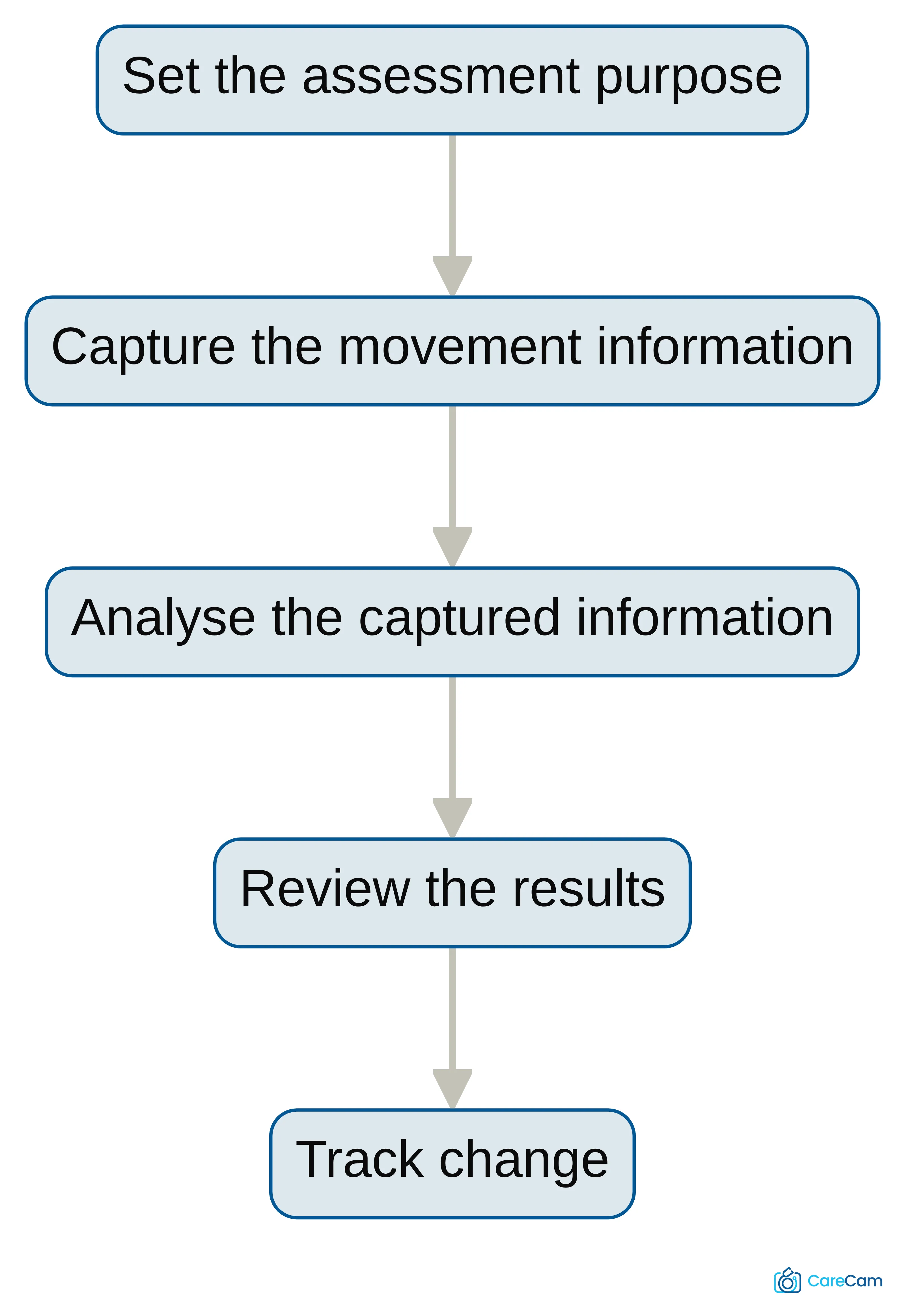
The CareCam assessment workflow has four practical stages: capture a short video, analyse it, review the results, and track changes over time. We also describe frailty assessment as using questionnaires and physical tests carried out by trained care teams, so the camera workflow should be considered alongside those parts of the assessment rather than in isolation.
Your organisation can think through the process in this order:
- Set the assessment purpose. Decide whether the immediate need concerns frailty, fall risk, a pre-operative assessment, post-operative recovery, neurological rehabilitation, orthopaedic care, or monitoring over time.
- Capture the movement information. Our described process involves capturing a short video. The surrounding assessment can also include questionnaires and physical tests carried out by trained care teams.
- Analyse the captured information. The assessment produces analysed movement information and, where applicable, a frailty report or related scores.
- Review the results. Your care team examines the findings with the wider clinical picture and identifies areas to focus on for care.
- Track change. We allow care teams to track changes in mobility and function, supporting timely adjustments to care.
This sequence gives you a process to evaluate, not a promise about a particular clinical outcome.
If you are considering this workflow, define the point at which the baseline is taken, who reviews later results, and how the information is brought into your existing record or care meeting.
How should movement findings be interpreted in frailty care?
Frailty assessment asks how movement findings fit within a wider picture of vulnerability. Frailty can involve physical, cognitive, and psychosocial dimensions, so movement information is one part of the assessment rather than a complete definition.
Care teams commonly use questionnaires and physical tests. Our assessment involves capturing a short video, analysing it, reviewing the results, and tracking changes over time. The useful question is how your team will interpret those movement findings with the rest of its frailty review.
The main operational difference is the possibility of using the same type of captured movement information at more than one point in a pathway. A pre-operative baseline can provide a reference for a later assessment, and changes in mobility and function can be reviewed during post-operative recovery. Your team still decides whether the comparison is clinically meaningful and what other information must be considered. For a useful comparison, keep the assessment purpose and review criteria explicit at each time point. A change in a movement measure is a signal for interpretation; it does not, on its own, establish the reason for the change.
A camera can describe movement-related features, but frailty can also involve cognitive and psychosocial dimensions. For that reason, camera-supported monitoring is better understood as an additional measurement layer than as a complete definition of frailty. Keep the wider assessment visible in your workflow.
Where could the information fit in care pathways?
The clearest CareCam pathway is around hospital surgery. We offer a baseline assessment before surgery, support assessment before and after surgery, and aid discharge planning for hospitals. In that setting, your team could consider movement information at the pre-operative assessment stage, during post-operative recovery, and when reviewing function before discharge.
The practical question is not whether every patient needs the same measurement. It is whether the information answers a defined question at a defined point in care.
The same type of information may be relevant in several settings:
- Hospitals: Use a baseline and later assessments to structure discussion about mobility and function around surgery and discharge planning.
- Rehabilitation centres: Use movement information to support review of change during a programme, with the rehabilitation team interpreting the findings alongside its established assessments.
- Aged-care operators: Consider whether mobility, balance, strength, or fall-risk information would add value to an existing review process.
- Neurological rehabilitation and orthopaedic care: Consider whether tracking movement and function supports the specific pathway your team already manages.
These are workflow possibilities, not universal indications. CareCam supports assessment before and after surgery, offers a baseline before surgery, and allows care teams to track changes in mobility and function; each setting should assess the fit with its existing review process.
The British Geriatrics Society links moderate or severe frailty identification with shared decision-making, advance care planning, proactive rehabilitation, and discharge arrangements. Our assessment can provide a frailty report and track changes in mobility and function. Your clinical team must decide how those findings relate to the person’s goals, wider assessment, and care plan.
Which CareCam capabilities are available, and which remain under study?
Vis-Frailty has a different status. We describe it as a self-guided frailty screening designed for population health, with an objective frailty score and scores for mobility, strength, balance, and fall risk.
Keep the assessment capabilities described as available separate from Vis-Frailty’s current study status and target timing. Do not treat a planned launch as a present deployment or a study-stage use as an established clinical result.
If your organisation is considering Vis-Frailty, ask which part of your proposed workflow concerns the study-stage product and which part concerns the assessment services already described. Keep that distinction in procurement, clinical governance, staff planning, and communications.
What can the assessment show—and what can’t it show?
The assessment also does not by itself determine a diagnosis, treatment plan, surgical decision, discharge decision, or care priority. Your team must interpret the findings with the wider clinical picture and the person’s goals. Our report identifies higher-risk areas and areas to focus on; it does not replace clinical judgment or established assessment methods. An output can therefore be useful for a narrower question: what movement-related features are present now, and how do they change when the same service reviews them again? It cannot explain every cause of a finding or represent dimensions that the capture does not measure. A result should be read with questionnaire responses, physical tests, functional information, and the wider clinical picture, including cognitive and psychosocial factors. Before comparing results, record which tool or service produced them, the purpose of the review, and who interpreted them. This protects against treating a change in one measure as proof that overall frailty has improved or worsened.
How should a hospital, rehabilitation centre, or aged-care operator evaluate fit?
Evaluate fit by starting with the care decision, not the camera. Our described workflow includes a short video, analysis, results review, progress tracking, and care planning, while our assessment also uses questionnaires and physical tests carried out by trained care teams. Your evaluation should test how those parts would work with your existing clinical process.
Use this checklist with your clinical, operational, and governance teams:
- Purpose: What decision should the assessment inform: pre-operative assessment, post-operative recovery, discharge planning, fall risk assessment, rehabilitation review, or longer-term monitoring?
- Population: Which patients or residents are in scope, and what wider assessment will accompany the movement information?
- Measures: Do you need a frailty report, mobility information, strength, balance, fall risk, or change in function over time?
- Workflow: Where will the short video be captured, who will review the analysis, and when will the result be discussed?
- Baseline and follow-up: Would a baseline before surgery or another defined starting point help you compare later assessments?
- Clinical interpretation: Which clinician or trained care team will decide what the result means and what action, if any, follows?
- Existing practice: How will the information sit alongside questionnaires, physical tests, comprehensive geriatric assessment, or falls assessment?
- Product status: Which part of the proposed workflow uses described assessment capabilities, and which part would depend on Vis-Frailty while it remains in clinical study?
- Evaluation criteria: What would make the process useful to your organisation: clearer review discussions, a structured baseline, tracked movement changes, or another defined operational need?
This checklist is a planning aid. It gives your team questions to work through; it does not establish that a particular implementation will produce a clinical outcome.
Pay close attention to the comparison with your existing fall risk assessment. Traditional assessment combines screening questions with timed tests, and results can vary between assessors. Our information describes objective measurements compared against normative ranges and tracked over time. Compare the two processes on the measures you actually need, the review time your team can provide, and the way findings will be recorded. Do not assume that a different capture method resolves every assessment challenge.
Once your team has a defined purpose and workflow question, you can contact us to discuss your objectives, requirements, or challenges and request a suitable solution. If the discussion includes Vis-Frailty, keep its clinical-study status and first-quarter 2027 target launch visible in the evaluation.
What should the organisation confirm before proceeding?
Confirm that your organisation has a defined clinical purpose, a named review process, and a clear boundary between movement measurement and wider frailty assessment. CareCam offers questionnaires and physical tests through trained care teams, a workflow involving short video capture and results review, and a baseline assessment before surgery that can serve as a reference for future assessments. Vis-Frailty remains in a clinical study with National Healthcare Group Polyclinics as of October 26, 2026, with a target launch in the first quarter of 2027.
If your hospital, rehabilitation centre, or aged-care service needs structured information about mobility, strength, balance, fall risk, or change over time, explore whether our assessment fits the pathway you have defined. A qualified clinician decides individual suitability and care, while your organisation decides whether the workflow, product status, and review responsibilities fit its service.
What should clinical and operational teams ask about a frailty assessment?
What is frailty syndrome?
Frailty syndrome is a state of increased vulnerability across multiple health domains, characterized by reduced physiological reserve and the ability to cope with acute stress. It is broader than a single symptom and can involve physical, cognitive, and psychosocial dimensions.
How is frailty commonly assessed?
Frailty is typically assessed using a combination of questionnaires and physical tests conducted by trained care teams. This approach helps identify signs and risk factors that suggest frailty.
What does the CareCam assessment workflow involve?
The CareCam assessment workflow includes capturing a short video, analyzing it, reviewing the results, and tracking changes over time. This process complements traditional assessments and provides additional movement information.
What limitations does the CareCam assessment have?
The assessment cannot provide a complete picture of frailty, as it does not encompass cognitive and psychosocial dimensions. It also does not determine diagnoses or treatment plans on its own.
How should organizations evaluate the fit of the CareCam assessment?
Organizations should evaluate the fit by defining the clinical purpose, identifying the patient population, determining the measures needed, and considering how the assessment integrates with existing workflows.
What is the status of the Vis-Frailty tool?
Vis-Frailty is currently in a clinical study with National Healthcare Group Polyclinics and is targeting a launch in the first quarter of 2027. It is important to distinguish its study status from the capabilities already available.
Next step
Have a question for CareCam?
Technical and clinical questions go to the team who built 3DGait and Vis-Frailty.
Get in touch