

Fall Risk Assessment
Should Singapore organisations explore AI video analysis for fall risk assessment?

Should you consider camera-based fall risk assessment?
You should consider camera-based movement analysis as an evaluation option when your Singapore hospital, rehabilitation centre, or aged-care home wants more objective movement information within a clinically governed process. You should not treat it as a replacement for clinical assessment, existing safeguards, or the professional judgment that gives movement findings their meaning.
The decision is therefore a workflow question, not a technology contest. Ask whether the proposed system can add useful movement measures for your population, setting, and care objective; whether staff can review those measures at the right point; and whether the result changes a decision you already need to make. Those boundaries matter if you are considering CareCam’s 3DGait, which we describe as assessing seniors’ mobility and fall risk.
This guide gives you a practical way to assess that fit. It separates what objective movement analysis may add from what it cannot establish on its own, compares it with manual scales and clinical assessment, and identifies questions about validation, privacy, workflow, staff adoption, and cost. It also separates our current descriptions of 3DGait and Vis-Frailty from conclusions that still need to be tested in your organisation. Some 3DGait modules and clinical uses, including Vis-Frailty, remain under clinical study.
What is a fall risk assessment meant to establish?
A fall risk assessment is meant to help your care team identify relevant signs of risk and decide what needs closer investigation or management. It is not simply a number attached to a person. A systematic review distinguishes an assessment tool that identifies whether someone is at high risk from a multifactorial assessment that investigates causes and helps determine which intervention may be needed. NICE guidance gives gait and balance assessment, including examples such as the Timed Up & Go and Turn 180° tests, as part of assessment when someone has fallen or is considered at risk.
A useful process also needs context. Comprehensive falls assessment should consider an older adult’s views about falls, their causes, future risk, and prevention, while the care plan reflects that person’s goals, values, and preferences. Gait and balance are only part of that picture. Your team may also need to consider the circumstances of a previous fall, changes in function, the care environment, and factors that affect how the person moves or responds during assessment. The exact process belongs to your clinical governance arrangements.
That distinction helps you define the output you need from technology. A movement system may quantify or describe features of walking and mobility, while your wider assessment asks what those features mean in context and what action follows. Our 3DGait product information says it assesses seniors’ mobility and fall risk. That description does not, by itself, establish a complete multifactorial assessment or determine an intervention for every setting. For an evaluation, define the handoff rather than asking whether the system gives a risk result. State which movement observation is produced, which part of the wider assessment it informs, who reviews it, and what further question the reviewer must answer. This makes a product output comparable with the work your team already does. It also prevents a mobility measure from being treated as a direct explanation of a fall, because movement assessment is distinct from investigating causes and choosing an intervention. In practical terms, the useful test is whether the output makes a defined review step clearer without removing the person’s history, concerns, goals, preferences, or the setting in which the movement occurred.
What can objective movement measures add?
Objective movement measures can give your team a more specific description of how someone moves during an agreed assessment activity. A scoping review of markerless motion-capture research searched studies through October 2024 and included 39 eligible studies with 3,114 participants: 30 examined fall risk, 7 examined frailty, and 2 examined both. Gait analysis was the most common markerless assessment for fall risk, with gait speed, stride length, and step width among the key parameters.
For your team, the practical value may lie in having movement features to review alongside the rest of the assessment rather than relying only on a broad impression. A systematic review reported that inertial sensors had potential for objective fall-risk assessment, but the studies used varied activities, outcome measures, and prediction or discrimination models. That variation means you should define what each measure is intended to inform before you treat it as useful in practice. The review does not show that inertial-sensor findings have the same meaning as camera-derived findings, nor does it establish that a particular feature predicts a fall in your service. It shows why the assessment activity, outcome definition, and comparison method should be recorded together. Ask which part of the proposed output comes from the movement recording and which part depends on interpretation. Then ask whether the same definition will be used when results are repeated or compared with another assessment. If CareCam presents 3DGait for a fall-risk use case, request the measure names, task conditions, intended population, and decision supported by each output. Keep the product description separate from the evidence question: our information says 3DGait assesses seniors’ mobility and fall risk, while the research review describes variation across studies rather than validating 3DGait itself.
Our 3DGait information says the system quantifies movement before and after surgery and supports return-to-activity decisions. For an organisation evaluating the system for fall-risk work, ask how that capability maps to your own use case: which movement measures would be collected, during which task, for which population, and how the results would enter a clinician’s review. A pre-operative assessment or post-operative recovery workflow may have different requirements from an aged-care mobility review, even when both involve movement.
The research also gives you a reason to avoid broad promises. Frailty-related movement features were less consistent than the gait features identified in the scoping review, and the umbrella review found inconsistent evidence for the Timed Up & Go test. Use objective measures to make a defined part of your assessment clearer, then test whether that information improves a decision your team actually makes. Do not assume that more measurements automatically produce a better assessment.
Why should objective analysis not stand alone?
A comprehensive process also considers the older adult’s views, the causes and circumstances of falls, future risk, prevention, and the person’s goals and preferences.
Your team should therefore separate three steps that are often compressed into one score: observing or measuring movement, interpreting the finding in context, and deciding what assessment or management follows. The NICE passage recommends assessing gait and balance when someone has fallen or is considered at risk while stating not to use a falls risk assessment tool. A separate review describes multifactorial assessment as the step used to investigate causes and determine which intervention may be needed.
Treat 3DGait as an adjunct within that sequence. Our product information says it assesses seniors’ mobility and fall risk and quantifies movement before and after surgery. Your operating procedure should still specify who reviews the output, which other information must be considered, how disagreements are handled, and what action is within the scope of the service. If your team cannot name the decision that the output supports, pause the evaluation before discussing scale.
Before using an objective movement result, make sure your process answers these questions:
- What movement feature was measured, and under what task conditions?
- Which part of the wider assessment does that feature inform?
- What patient views, history, environment, or functional changes must be added?
- Who interprets the result and records the decision?
- What happens when the result does not fit the wider clinical picture?
Those questions keep the technology inside a governed assessment rather than turning it into an automatic conclusion.
How does this compare with manual scales and clinical assessment?
Manual scales, objective movement analysis, and broader clinical assessment answer different questions. A review identified fall-risk tools designed for different settings and populations, including rehabilitation, home care, emergency departments, and stroke care. A sensing-technology review also found variation in activities, outcomes, and prediction models. Use the comparison below to decide what you need to test, not to assume that one approach is sufficient.
| Option | What it can contribute | Workflow questions | Interpretive boundary |
|---|---|---|---|
| Manual scale | A structured score or set of items, depending on the instrument and setting | Who completes it, when is it repeated, and does the score inform a real decision? | Tools differ by population and setting; a score does not replace a broader assessment |
| Objective camera or motion analysis | Quantified movement features such as gait speed, stride length, or step width may give the team more detail about movement | What camera setup, task, staff role, review time, and data pathway are required in your site? | Research methods and outcomes vary, and no single movement assessment should predict falls alone |
| Broader clinical assessment | Context about falls, causes, concerns, goals, preferences, gait, balance, and other relevant factors | How will the team combine findings and record the decision? | It requires a defined clinical process rather than a single automated output |
The comparison also reflects known limits of existing tools. A 2025 review passage identifies time demands, subjective judgments, static risk factors, and limited attention to changing hospital conditions as limitations of existing fall-risk tools for hospitalised older adults. That does not prove that camera analysis solves each limitation. It tells you what to examine: whether the proposed workflow captures movement in the way your service needs, whether staff can act on the output, and whether the output remains meaningful as a person’s condition changes. Use the purpose of the assessment to set the comparison. If the immediate need is a structured intake item, compare how a manual scale is completed and interpreted in that setting. If the need is to describe movement or compare movement at two time points, test whether the proposed objective workflow captures the same task under sufficiently similar conditions. If the need is to understand why someone may fall, neither a scale nor a movement output answers that question alone; the wider assessment must supply the context. This does not make one option universally preferable. It gives your procurement team a way to compare like with like and to reject a feature that has no defined role in care.
For a CareCam evaluation, compare your current process with the actual 3DGait workflow rather than comparing labels. Record the task, equipment, staff time, review steps, output, and follow-up decision for each approach. Our product information says 3DGait quantifies movement before and after surgery and supports return-to-activity decisions. Your organisation still needs to establish whether those functions fit fall-risk assessment in your particular hospital, rehabilitation service, or aged-care home.
What should Singapore organisations make of the guideline differences?
You should treat the guideline difference as a scope and governance issue, not as permission to select whichever recommendation supports a preferred technology. One current guideline passage says evidence does not support using a falls risk assessment tool in hospital and recommends comprehensive assessment for hospital inpatients over 65. The NICE CKS passage also says not to use a falls risk assessment tool, while recommending gait and balance assessment after a fall or when fall risk is suspected.
The passages come from United Kingdom guideline contexts and are not a Singapore protocol. Their practical lesson for your organisation is to define the intended use precisely. A movement analysis used to support a clinician’s review is a different proposition from an automated tool that labels someone high or low risk and drives care without further assessment. Your local clinical governance group should decide how any proposed use fits Singapore requirements, service policy, and professional responsibilities.
Ask CareCam to describe where 3DGait sits in that process. Our product information says it assesses seniors’ mobility and fall risk, but that statement does not settle whether your service should use it for screening, assessment support, monitoring, research, or another purpose. Write the intended use in one sentence before you compare systems. Then ask whether the proposed output and review pathway match that sentence.
A sound evaluation should preserve the distinction between identifying a possible risk and understanding its causes. A review recommends a multifactorial assessment to determine which intervention may be needed, while the umbrella review cautions against using one mobility assessment in isolation to predict falls. Keep both points visible in your protocol, especially if your service is considering a numerical or categorical output.
What would an evaluation workflow need to show?
An evaluation workflow needs to show more than whether a camera can capture movement. It needs to show how your organisation would define the use case, set up the assessment, review the output, combine it with clinical information, and follow up on the decision. We state that our solutions can fit into clinical workflows, but your team must test what that means in your own setting, population, staffing model, and governance process.
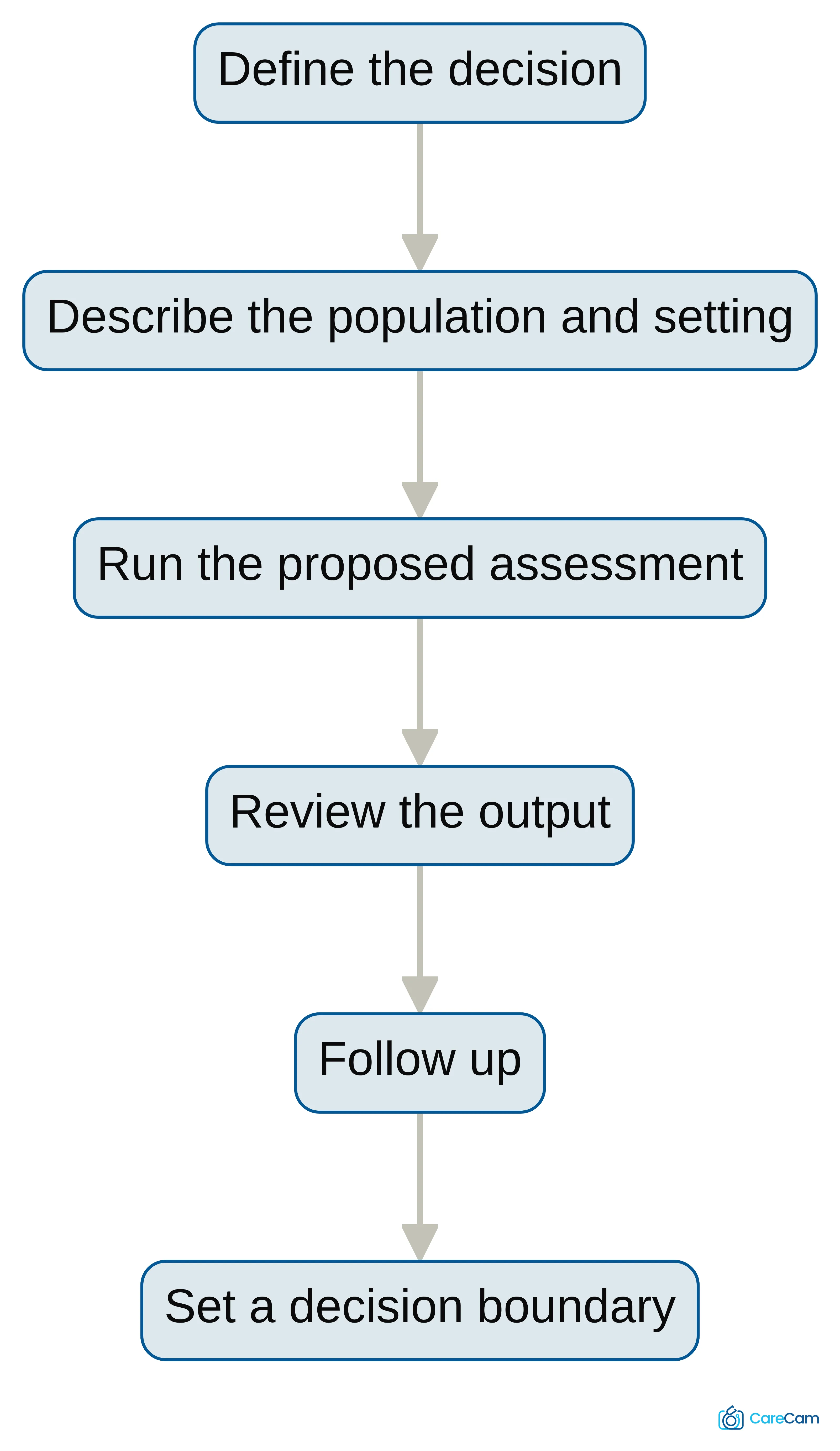
Use a staged evaluation:
- Define the decision. State whether the proposed use is to describe mobility, support a wider assessment, monitor change, or inform another defined decision. Do not begin with a generic goal such as improving safety.
- Describe the population and setting. Include the service, age range, mobility range, relevant conditions, assessment location, and staff who would use the result. A hospital ward, rehabilitation gym, and aged-care home may create different workflow requirements.
- Run the proposed assessment. Document the task, instructions, camera position or other equipment, time required, assistance provided, failed attempts, and conditions that affect the result. Ask CareCam which conditions are required for a valid output.
- Review the output. Record what the system produces, who sees it, how long review takes, and which part of the assessment it informs. Compare the output with the decision your team would otherwise make.
- Follow up. If your use case involves change over time, define the repeat schedule, the measure being compared, and the action that follows a meaningful change. Our 3DGait information includes movement quantification before and after surgery; your evaluation should establish whether that comparison is relevant to your chosen use case.
- Set a decision boundary. Specify when staff must seek further assessment, disregard an unusable result, or escalate a concern through existing clinical procedures.
Keep a simple record for each evaluation session. Capture the agreed task, the output received, the staff time used, the interpretation, the resulting action, and any reason the process could not be completed. Use the record to make the evaluation auditable without turning it into a claim about performance. For each session, link the intended decision to the task and setting; note whether the person completed the task and what assistance or condition affected it; and preserve the output in the form in which the reviewing staff saw it. Record the interpretation separately from the movement result, then note the action or reason no action followed. This distinction lets the organisation ask whether a change came from the person, the assessment conditions, the interpretation, or the follow-up process. It also makes a product discussion more precise. CareCam’s product information covers 3DGait’s assessment of seniors’ mobility and fall risk and its movement quantification before and after surgery, but it does not supply your site’s task, review role, or decision rule. Those are the details your evaluation record must establish. Before a pilot, agree what a useful session would look like without setting an unsupported accuracy or time target. The session should have a stated decision, a defined task, a usable output or recorded reason it was unavailable, a named reviewer, and a documented next step. Review the record with clinical, operational, and governance leads. Ask where the process broke: task completion, equipment conditions, output interpretation, documentation, or follow-up. This separates a limitation of the movement measure from a limitation of the surrounding workflow. Repeat the review for the settings you intend to serve rather than treating one successful demonstration as evidence for every ward, therapy area, or aged-care environment. If the proposed use is before and after surgery, keep the task and comparison conditions visible in the record; if it is fall-risk work, state how the output enters the wider assessment instead of allowing the label to become the decision.
What does CareCam currently say about 3DGait and Vis-Frailty?
As of October 26, 2026, our 3DGait product information says that 3DGait assesses seniors’ mobility and fall risk. It also says that 3DGait quantifies movement before and after surgery and supports return-to-activity decisions. These are CareCam product descriptions. Use them to frame questions about a demonstration and intended use, not as a general finding that applies to every organisation or population.
Our Vis-Frailty product information says that Vis-Frailty generates a frailty report highlighting individuals at higher risk and areas to focus on for care. It also says that Vis-Frailty provides an objective frailty score, along with scores for mobility, strength, balance, and fall risk. Those descriptions may be relevant if your service is considering a frailty assessment alongside mobility review, but they do not make Vis-Frailty interchangeable with a comprehensive clinical assessment.
The status of each product matters. Our FAQ says that 3DGait is still undergoing clinical study for some modules and clinical uses, including Vis-Frailty. Our Vis-Frailty information says the product is in a clinical study with National Healthcare Group Polyclinics. Separate the functions described for a product from the clinical evidence and operational validation you need for your proposed use.
What remains unestablished about the CareCam offerings?
Your organisation should treat several decision-critical details as questions to resolve rather than assumptions. CareCam’s product information describes functions for 3DGait and Vis-Frailty, while the wider markerless-motion literature contains varied activities, parameters, and study designs. That combination makes local fit more important than a product label.
Before you approve a pilot or procurement discussion, ask for clear answers on:
- Accuracy and reference standard: What outcome is the system intended to estimate or describe, and what comparison method supports that use?
- Population: Which ages, mobility levels, diagnoses, assistive devices, and communication needs have been evaluated?
- Setting: What room, lighting, clothing, camera position, task instructions, and staff assistance are required?
- Workflow: Who starts the assessment, who reviews the output, how long each step takes, and where the result is recorded?
- Change over time: Which measure can be compared across sessions, and what conditions must remain consistent?
- Privacy and access: What information is captured, retained, transferred, and visible to which roles? What are the organisation’s responsibilities for approval and oversight?
- Cost: What costs apply to equipment, setup, integration, training, support, maintenance, and repeated assessments?
- Clinical status: Which functions are available for your proposed use, which remain under clinical study, and what evidence applies to the exact module?
Do not use an accuracy figure, staff-time claim, fall-prevention claim, or cost assumption unless it is tied to the exact system, task, population, setting, and comparison being discussed. The research literature includes inconsistent findings for some mobility assessments and variation in sensing methods. Your evaluation should therefore record the conditions behind each result rather than treating a single demonstration as a general performance statement.
How should you treat Vis-Frailty’s clinical status and timing?
As of October 26, 2026, our Vis-Frailty information says that Vis-Frailty is in a clinical study with National Healthcare Group Polyclinics and has a target launch in the first quarter of 2027. Our FAQ also says that 3DGait remains under clinical study for some modules and clinical uses, including Vis-Frailty. The first-quarter 2027 date is a target, not a promise that the product is available for your intended use on that date.
Keep three questions separate in your planning. First, what does the product description say it is intended to provide? Second, what clinical study is under way, for which use and population? Third, what evidence and governance approval would your organisation require before using the output in care? A frailty report or objective score may be relevant to your planning, but the existence of a report does not decide how your service should act on it.
If your decision depends on Vis-Frailty, ask CareCam to state the status that applies on the date of your discussion, the intended use of the clinical study, the functions available for evaluation, and the conditions attached to any target launch. Document those answers in your project plan. Do not build a patient pathway around a future date or an under-study module without a defined contingency.
Which validation and governance questions should you ask?
Validation should test the exact decision you want to support, not just whether the system produces a movement output. The markerless-motion review found that studies used different activities and extracted different features, while the umbrella review found that no single mobility assessment should be used alone to predict falls. Your questions should therefore cover the intended use, population, reference method, operating conditions, interpretation, and action.
Ask these validation questions:
- What exact outcome does the system produce: a movement measure, a score, a report, or a risk estimate?
- What does each output measure, and what does it not measure?
- Which reference assessment or clinical outcome is used for comparison?
- How were participants selected, and does that population resemble your Singapore service?
- Were hospitals, rehabilitation centres, aged-care homes, or community settings represented separately?
- How are results affected by walking aids, assistance, limited mobility, cognitive impairment, clothing, or inability to complete the task?
- What happens when the recording is incomplete or the output cannot be generated?
- Which conditions must remain consistent if you compare results before and after surgery or across follow-up visits?
- What level of variation should your team expect between repeated assessments?
- What result would make you stop, revise the workflow, or seek another assessment?
Ask these governance questions as well:
- Who owns the decision supported by the output?
- Which qualified staff may interpret it, and what training do they need?
- How will the output be documented alongside the person’s history, concerns, goals, and preferences?
- What is the escalation route when the output conflicts with observation or other assessment findings?
- How will you explain the assessment to the person and obtain the approvals your organisation requires?
- What data are captured, where are they stored, how long are they retained, and who can access them?
- How will your team audit use, corrections, failed assessments, and changes to the system?
- What is the process for reviewing a module that remains under clinical study?
For a CareCam discussion, ask the team to answer each question for the specific 3DGait or Vis-Frailty function you are considering. Our product descriptions cover mobility, fall risk, frailty, strength, balance, and movement before and after surgery, but those terms can support different decisions in different services. A precise use statement will help you distinguish a demonstration of product function from validation for your organisation’s care pathway. Keep evidence questions in layers. First, establish whether the system can produce the stated output under the conditions your service can provide. Next, establish whether the output corresponds to the movement or risk concept it is being used to describe. Finally, establish whether clinicians can interpret it consistently enough for the intended workflow and whether the result supports a documented action. A positive answer at one layer does not settle the next. For example, a generated report can exist without showing that its score is appropriate for your population or that staff should act on it. Ask CareCam to label which answers come from product documentation, clinical-study results, or your own local evaluation. This record will help your governance group avoid treating a product description as validation for a care decision.
How can staff assess workflow fit and adoption?
Staff adoption depends on whether the assessment makes sense in daily work and whether staff understand what to do with the result. A senior-living case study reports that staff training and demonstrations helped build trust and support adoption, while caregivers wanted to see data captured before a fall. That case is not evidence of CareCam’s results, but it supports a practical evaluation question: can your staff see the relationship between the output, the person’s needs, and the action your service can take?
Plan separately for each setting. A digital-approaches review reports that hospital systems often directed alerts to nurses, while long-term-care systems used broader sensor coverage and often notified caregivers or family members. Your proposed movement-assessment workflow may not involve alerts, but the difference shows why you should map the receiving role, review point, response time, and documentation path rather than transfer a workflow from one setting to another.
Use a staff trial to check:
- whether the assessment fits existing appointments, rounds, therapy sessions, or reviews;
- whether the person conducting it can follow the instructions without extra workarounds;
- whether the output is understandable to the staff who must act on it;
- whether review adds work, removes a step, or changes who is responsible;
- whether staff know how to handle an incomplete or unexpected result; and
- whether managers can monitor use without turning the output into an unsupported performance target.
Your staff trial should establish the fit for your service rather than assume it from that general statement. After the trial, collect feedback from the person conducting the assessment, reviewing the output, and responsible for follow-up. Ask each role to identify the step they could complete, the information they lacked, and the point at which responsibility was unclear. Compare those answers with the written procedure. If staff understand the output but cannot connect it to an action, the issue is decision design rather than training alone. If the task or output fails under ordinary assistance or mobility conditions, record that as a population or setting question for validation. Use the findings to refine the demonstration questions and governance review, not to create an unsupported claim about staff time or fall outcomes.
What should you request in a CareCam discussion or demo?
Bring this checklist:
- the decision you want the output to support;
- the population and setting you want to evaluate;
- the task, equipment, and operating conditions required;
- the output and the meaning of each measure or score;
- the reference method and validation results for a comparable population;
- the workflow from setup through review, documentation, and follow-up;
- staff roles, training, time, and handling of failed assessments;
- privacy, access, retention, governance, and cost questions; and
- the status of each module, especially any function that remains under clinical study.
Ask specifically how 3DGait’s stated mobility, fall-risk, and movement-quantification functions apply to your use case. If you are considering Vis-Frailty, ask separately about its clinical study with National Healthcare Group Polyclinics and its target launch in the first quarter of 2027. Treat that date as a target and keep a contingency in your plan.
The decision to explore objective movement analysis is reasonable when it is tied to a clear workflow, measured against a relevant reference, and reviewed with the wider clinical picture. It is not a substitute for understanding causes, concerns, goals, preferences, gait, balance, and changing conditions. For any individual patient, a qualified professional must decide suitability and action within the organisation’s clinical governance process.
Next step
Have a question for CareCam?
Technical and clinical questions go to the team who built 3DGait and Vis-Frailty.
Get in touch