

fall risk patient
Patient fall risk: how care teams can combine clinical screening with objective movement assessment
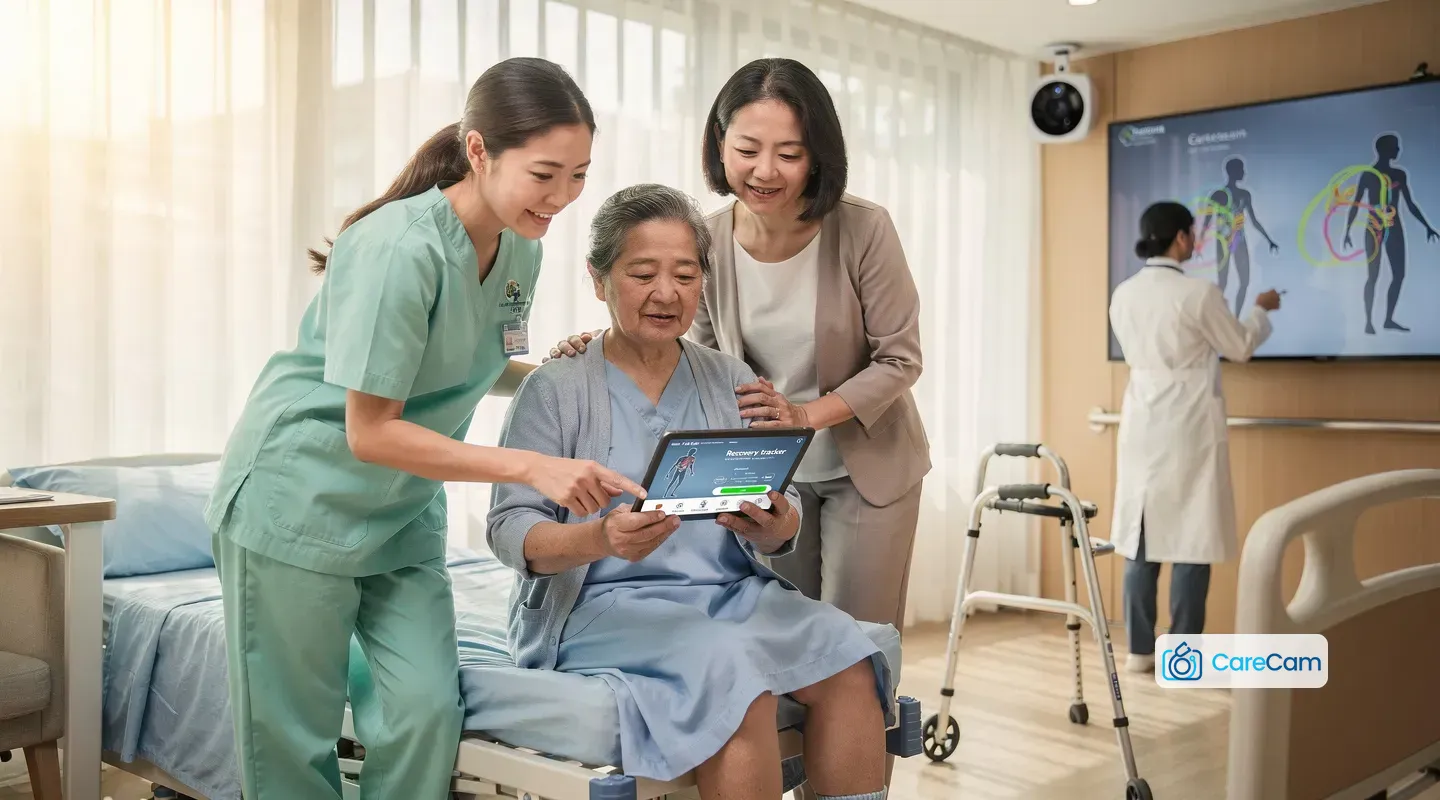
What should a fall-risk review record capture?
A useful fall-risk review record links the care question, clinical information, movement findings, and clinical interpretation. The clinical part starts with the care question and available information, including a history of falls, mental status, elimination, mobility, sedative or hypnotic use, timed tests, and observation; a repeated entry also identifies the earlier result used for comparison. The movement part records findings from a short video after analysis. The clinician or care team then records how those findings relate to the person’s history, setting, and current care needs. A patient fall is an unplanned descent to the floor, with or without injury; it may be assisted or unassisted.
Healthcare settings can increase fall risk because they may be stressful, unpredictable, and unfamiliar to patients. A score or video measure can describe part of the picture, but it cannot decide an individual patient’s diagnosis or care plan by itself. Your team still needs to connect the result with clinical history, observation, and the setting where care takes place.
How should a team prepare the review record?
Before choosing a measurement, use the four-question check below. A defined purpose tells the team what information is relevant and what the result can reasonably contribute. It also stops a movement output from being treated as a general measure of health or as a decision on its own. The question should identify the patient group, the care setting, the information already available, and the person or team who can interpret the output. It should state what a meaningful change would prompt the team to review. That keeps the measurement tied to a care decision without turning it into a diagnosis. The check tests whether the proposed assessment fits a defined care question, the information already collected, the conditions for comparison, and the team’s ability to interpret the result.
A practical starting point is to define four points:
- The person and setting: Decide which patient group and care environment the workflow covers.
- The decision point: State whether the assessment supports initial screening, a focused review, a rehabilitation review, discharge planning, or comparison across visits.
- The information already collected: Record the falls history, clinical observations, screening questions, and timed tests already used by the team.
- The review owner: Name the qualified professional or team responsible for interpreting the result and deciding what happens next.
This structure keeps a movement measure connected to care instead of treating it as a stand-alone score.
Our Fall Risk Assessment service is designed to sit alongside traditional assessment, which combines screening questions with timed tests and can vary between assessors. If your organisation is considering it, define the existing workflow first, then decide where an objective comparison would answer a useful question.
What belongs in the starting clinical record?
Conventional fall-risk assessment usually begins with questions and observations, then moves to a focused assessment when the initial information suggests a concern. We combine screening questions with timed tests in traditional fall-risk assessment, and results can vary between assessors.
A documented workflow may screen for:
- a history of falls;
- altered mental status;
- altered elimination;
- altered mobility; and
- sedative or hypnotic use.
The workflow passage also describes a focused assessment followed by a risk-specific plan. These items are examples of information a team may organise in its process, not a universal scoring rule for every service.
A comprehensive falls assessment can be provided by a specialist falls service or another appropriately governed setting with trained professionals. Different healthcare professionals may complete different parts across primary, community, and specialist outpatient services, so the process should make handoffs clear.
Can movement results be compared over time?
A single fall-risk score can be an incomplete picture because walking and balance can change over time. Older adults can show greater variability in basic spatial and temporal gait measures than younger adults, and walking may fluctuate across hours, days, and weeks.
Increased gait variability may indicate poorer locomotor coordination, but inconsistent walking in older adults can also affect measurement reliability. That means a change in a result needs context: consider the person’s condition, the task, the environment, and whether the assessment was repeated in a comparable way.
A useful review therefore asks more than whether a score is high or low. Ask what changed, whether the change appeared across repeated assessments, and whether it matches the clinical picture. The result should guide a discussion, not replace it. For an organisation, this suggests separating two questions in the review record: “What does the current assessment show?” and “Is the difference consistent enough to discuss as a change?” The first concerns the current task and result. The second requires comparison with an earlier assessment made under conditions the team considers comparable. If the task, setting, or person’s condition differs, record that difference rather than treating the values as a clean trend. This does not create a universal threshold. It gives the reviewer a transparent reason for accepting, qualifying, or repeating a comparison. It also makes handoff easier because the next clinician can see which result was reviewed, what context was considered, and why the team did or did not change the care discussion.
For surgical pathways, we offer a baseline assessment before surgery as a reference point for future assessments. That reference can help a hospital compare later findings with an earlier measurement, while the care team still decides what the difference means for that patient.
When can movement results be compared over time?
Movement assessment is relevant when a defined care question needs recorded movement information that can be reviewed again under comparable conditions. Markerless motion capture may reduce data collection and processing time compared with marker-based methods, but it still has limitations and challenges for clinical integration. For each review, record the exact movement measure, population, task, recording conditions, and intended comparison. Older adults’ walking can vary from hour to hour, day to day, or week to week, so a difference between entries needs that context. The record should show whether the task and conditions were comparable before the team treats a change as something to review. This makes the method a way to document a movement comparison, not a complete fall-risk assessment.
Our 3DGait service assesses seniors’ mobility and fall risk. In a care pathway, that service can be considered as an additional movement assessment alongside the team’s established history, screening, timed tests, and clinical review.
The practical value comes from making comparable information available at the point where your team needs to review change. The measure does not identify every cause of falling, determine individual suitability for care, or prescribe an intervention without professional interpretation.
How should a camera-based result enter the record?
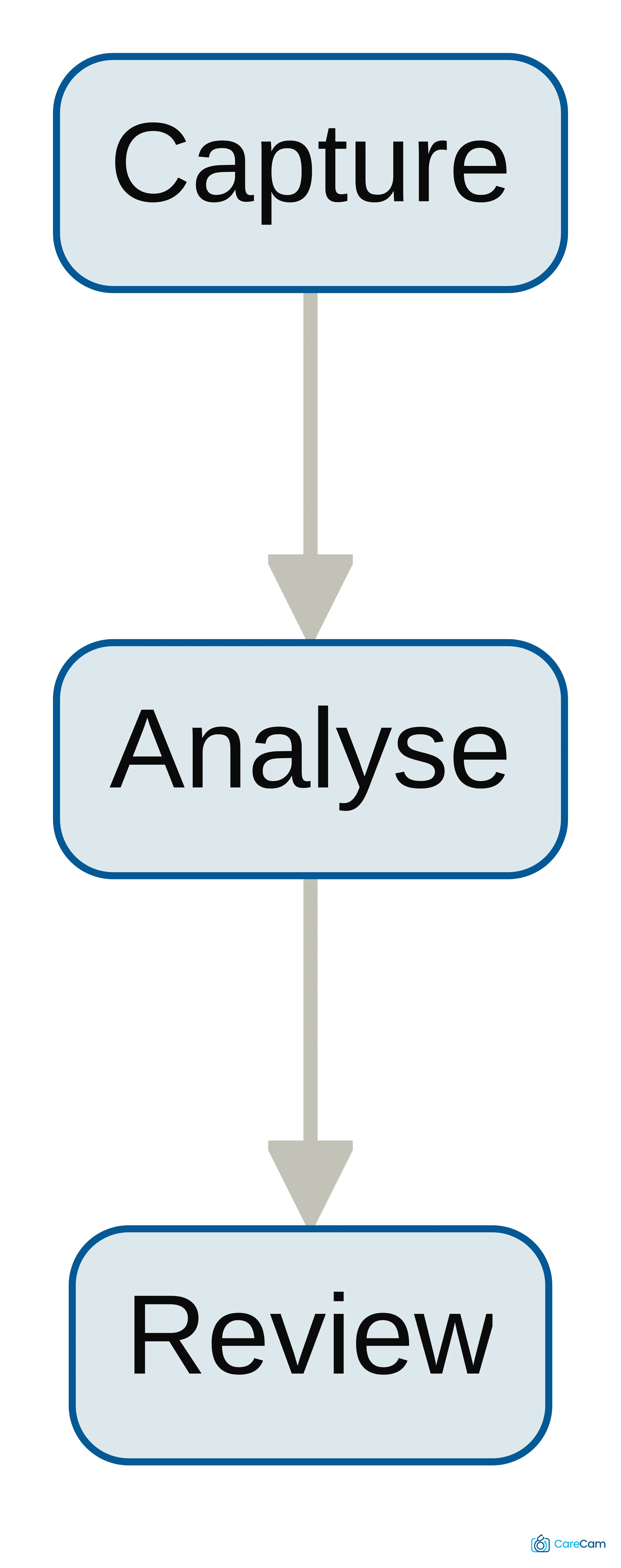
Our assessment workflow captures a short video, analyses it, and reviews the results to track progress and plan care. For a repeated review, enter the movement task, recording conditions, and review question in the record before the video is captured.
In practical terms, the team can organise the workflow into three stages:
- Capture: Record the agreed movement task under the conditions defined by your service.
- Analyse: Process the video to produce the available objective measurements.
- Review: Place the results beside the patient’s clinical information and earlier assessments before planning care.
The final stage matters. A measurement becomes useful only when the responsible care team can relate it to the question that led to the assessment.
We compare objective measurements with normative ranges and track them over time. Treat those comparisons as information for review, not as a diagnosis or a universal threshold that applies in every setting.
Markerless motion capture has potential limitations and unresolved challenges for clinical integration. Before use, define the recording conditions, review process, and escalation path that your organisation can support. Before adopting the workflow, an organisation can run a process check using a pathway already under review. Ask whether staff can identify the movement task, capture the short video under the agreed conditions, locate the resulting measurements, and bring them to the responsible reviewer with the clinical record. The point of this check is workflow fit, not proof that the system predicts falls. If the output cannot be linked to an identified decision or reviewed by the team responsible for care, the organisation has not yet defined a useful role for it. If it can, document that role narrowly, such as comparison across visits or support for a recovery review, rather than treating the output as a complete fall-risk assessment.
Who owns interpretation and follow-up?
Interpretation should bring together the patient’s falls history, mobility observations, timed tests, current condition, and movement results. Because walking can vary across hours, days, and weeks in older adults, a difference between visits needs clinical context. The review entry should identify the earlier assessment, note whether the conditions were comparable, and name the professional who considered the difference before the care plan changes.
We help care teams track changes in mobility and function to support timely adjustments to care. Our role is to provide assessment information; the treating professionals remain responsible for interpretation and care decisions.
How can Singapore services use a review record?
Singapore hospitals, rehabilitation centres, aged-care homes, and community services can use a review record at points where teams already screen, review mobility, or plan transitions. We’re used in hospitals and rehabilitation for assessments during recovery and before discharge. A hospital entry may support an admission or discharge review, while a rehabilitation or community entry may follow change across visits. Record the local question and responsible reviewer so the same label—fall risk—does not hide different review points. General information cannot determine an individual patient’s fall risk or replace the professionals responsible for care. Local governance and the team’s documented process remain part of the decision.
We support routine assessments for older adults in primary and community care settings. That makes the workflow relevant when a service needs to compare movement information during repeated reviews, provided the result fits the service’s clinical process and governance arrangements.
The setting changes the practical question:
- Hospital care: The team may need information during an admission or before discharge.
- Rehabilitation: The team may compare movement findings during recovery reviews.
- Aged-care services: The team may use repeated assessments as part of an established review process.
- Community care: The team may consider whether routine assessment fits existing visits and referral pathways.
These are workflow locations, not promises of a particular outcome.
NICE guidance from England and Wales recommends comprehensive falls assessment and management in hospital inpatient and residential care settings, but that guidance is not Singapore policy. Use it as a reference for the role of comprehensive assessment, then apply your organisation’s local clinical governance and professional requirements.
How might the assessment support different care pathways?
Different care pathways can use the same assessment principle while asking different questions. Start with the pathway’s decision point, then choose the measurement and review interval that match it.
Hospital and rehabilitation pathways. We’re used in hospitals and rehabilitation for assessments during recovery and before discharge. Your team can decide whether a movement measure belongs at admission, during recovery review, before discharge, or at another documented point in the pathway.
Surgical pathways. We support pre-operative and post-operative assessments and aid discharge planning in hospitals.
Older-adult and community pathways. Our 3DGait service assesses seniors’ mobility and fall risk, and we support routine assessments for older adults in primary and community care settings. The service still belongs within the existing clinical screening and review process.
Frailty-related pathways. Our Vis-Frailty service provides an objective frailty score plus scores for mobility, strength, balance, and fall risk. Our Vis-Frailty service is in a clinical study with National Healthcare Group Polyclinics and targets launch in the first quarter of 2027, so treat its study status and intended timing as part of the organisation’s evaluation rather than as proof of suitability for every clinical use.
What should the record show when movement data is limited?
Movement data should be treated as one part of a clinical assessment, not as a stand-alone answer. Markerless motion capture has limitations and unresolved challenges for clinical integration, and older adults’ walking can vary across hours, days, and weeks. Verification also includes the limits of the output. A movement measure may describe selected features of a recorded task, while the wider assessment covers history, health status, surroundings, and current care needs. Those sources answer different parts of the care question. Keeping them together helps the team explain what the result does show, what it does not show, and what remains for clinical judgement.
Before relying on the result in a workflow, your organisation should check:
- Purpose: What decision will the measurement inform?
- Population: Does the intended patient group match the population for which the measure has been studied or configured?
- Repeatability: Can your team repeat the task under comparable conditions and record relevant changes?
- Clinical review: Who will interpret the result alongside history, screening, timed tests, and observation?
- Action: What response follows a meaningful change, and who documents it?
- Workflow fit: Can staff capture the video, review the output, and include it in the existing care process?
These checks keep the assessment connected to a defined decision and a responsible care team. One way to make them operational is to assign each assessment a short review record. It can state the purpose, the task recorded, the available clinical context, the earlier result used for comparison, the professional who reviewed it, and the action or reason for no change. This is not a new clinical score. It is a way to keep the objective output attached to the decision it was meant to inform. The record should also show when comparison was limited, such as when the task or assessment conditions were not comparable, or when the person’s walking had changed across time. That makes uncertainty visible instead of turning a qualified measurement into a definite conclusion. For an organisation evaluating CareCam’s Fall Risk Assessment service, this record also provides a concrete way to judge whether the service fits the documented process.
Do not use a movement result to claim that a patient will or will not fall, to replace a clinician’s judgement, or to select care without considering the wider assessment. Set that boundary before the workflow goes into routine use.
What is the sensible next step for an organisation?
An organisation evaluating objective fall-risk assessment should map its existing clinical process before selecting a measurement. Identify the patient group, the decision points, the current screening and timed tests, the review team, and the action that should follow a meaningful change.
A practical evaluation can begin with a defined pathway, such as recovery review or discharge planning, then compare how the objective result fits beside the information your team already uses. We support assessments before and after surgery and aid discharge planning in hospitals, so those pathways may provide a clear setting for organisations already reviewing mobility around care transitions.
Keep the final decision with the qualified professionals responsible for the patient’s care. A comprehensive assessment should identify relevant fall-risk factors, and the care team should use those findings to plan a response suited to the individual and the setting.
What should an organisation ask before adopting camera-based assessment?
What is a patient fall risk?
A patient fall risk refers to the likelihood of a patient experiencing an unplanned descent to the floor, which can occur with or without injury. This risk is influenced by various factors including the patient’s history, movement, health status, and the care environment.
What does a conventional fall-risk assessment include?
A conventional fall-risk assessment typically involves screening questions about the patient’s history of falls, mental status, mobility, and medication use, followed by focused assessments if initial concerns arise. This process helps identify individual risk factors.
How can objective movement measurement enhance fall-risk assessment?
Objective movement measurement can provide a structured comparison layer to traditional assessments, allowing care teams to track changes over time and make informed decisions based on consistent data rather than subjective observations alone.
What is the workflow for a camera-based fall-risk assessment?
The workflow for a camera-based fall-risk assessment involves capturing a short video of the patient’s movement, analyzing the video to obtain objective measurements, and then reviewing these results alongside clinical information to inform care planning.
Who is responsible for interpreting the results of a fall-risk assessment?
The clinician and care team are responsible for interpreting the results of a fall-risk assessment. They must consider the patient’s history, mobility observations, and the context of the assessment to make informed care decisions.
How does fall-risk assessment fit into Singapore's healthcare settings?
In Singapore, fall-risk assessments can be integrated into hospitals, rehabilitation centers, aged-care homes, and community services, particularly at points where teams already conduct screenings or plan transitions in care.
What should teams verify before relying on movement data for fall-risk assessment?
Teams should verify the purpose of the measurement, ensure it matches the intended patient population, confirm the repeatability of the assessment, and establish who will interpret the results and decide on subsequent actions.
Next step
Have a question for CareCam?
Technical and clinical questions go to the team who built 3DGait and Vis-Frailty.
Get in touch