

fall prevention for elderly
How Singapore care organisations can use objective fall-risk assessment
What should a Singapore care organisation do first?
A Singapore care organisation should start with a prevention process, not with a device or score. Define how your team identifies fall risk, reviews contributing factors, chooses tailored actions, and follows up before deciding whether objective video measurement belongs in that process.
NICE recommends comprehensive falls assessment and comprehensive falls management for people in hospital inpatient and residential care settings. That recommendation comes from NICE guidance and should be treated as an external reference rather than a Singapore protocol. The same guidance also describes a community pathway for people who do not need comprehensive falls management but may benefit from specific interventions to reduce fall risk. Your local clinical governance, care model, and Singapore requirements still determine how you apply any recommendation.
A useful starting process has four linked questions:
- Who needs a fall-risk assessment, and when will your team repeat it?
- Which factors will the assessment examine, such as mobility, balance, medicines, cognition, or the care environment?
- Who will review the findings and agree on an intervention or monitoring plan?
- How will your team record whether the plan needs adjustment?
Our traditional fall-risk assessment combines screening questions with timed tests, and these tests can vary between assessors. These features can make a workflow more reviewable, but they do not decide which intervention an older adult needs.
Begin by mapping your existing pathway. Identify where assessment already happens, where staff record findings, and where care teams discuss prevention. Then ask whether a repeatable movement measure would answer a real workflow question. If it would not change review, communication, or follow-up, adding another assessment step may not solve the problem you are trying to address.
How should the approach differ by care setting?
Hospitals, rehabilitation centres, and aged-care operators need different starting points because the reason for assessment, the people reviewing it, and the next care decision may differ. The table below is a planning aid, not a clinical protocol.
| Care setting | Start with | Use measurement to support | Keep the boundary clear |
|---|---|---|---|
| Hospital inpatient care | The admission, transfer, or change in condition that brings fall risk into team discussion | A shared view of movement findings alongside the wider assessment and care plan | A movement result does not replace comprehensive assessment, bedside observation, or local inpatient procedures |
| Rehabilitation centre | The functional question being followed during rehabilitation and the team’s agreed review points | Comparison of movement results across visits when the same type of question is being revisited | A change in a measure does not by itself establish why the change occurred or which treatment should follow |
| Aged-care setting | The organisation’s process for identifying residents who need assessment and prevention planning | A repeatable record that can be discussed by the care team and linked to tailored actions | A routine measurement does not prove that a fall will be prevented or that a resident is suitable for every module |
NICE recommends comprehensive assessment and management in hospital inpatient and residential care settings. Your organisation should therefore define which pathway applies before it selects a tool.
We state that CareCam supports routine assessments for older adults in primary and community care settings. That first-party scope does not automatically establish suitability for every Singapore hospital, rehabilitation centre, or aged-care workflow. If your setting falls outside that stated scope, treat local workflow testing and clinical review as conditions of evaluation rather than assuming that the same process transfers unchanged.
The practical question is simple: what decision will the measurement support in this setting? If the answer is unclear, improve the assessment pathway first. If the answer is clear, specify who captures the information, who reviews it, and what action remains under professional judgment.
What should an organisational fall-risk process examine?
An organisational fall-risk process should examine the person’s movement, health context, medicines, surroundings, and current support plan before the team chooses a prevention action. A single score rarely describes the whole situation.
The cited AHRQ PSNet primer identifies delirium, psychoactive medicines such as benzodiazepines, and baseline difficulties with strength, mobility, or balance as fall-risk factors in older patients. Those factors give your team a practical starting point for a structured conversation. They do not create a complete assessment by themselves, and they should be interpreted within the person’s clinical context.
Your process can make room for these areas:
- Recent falls and near-falls: Record what happened, where it happened, and what changed around the event when that information is available.
- Mobility and balance: Note the person’s observed movement and any timed test or other measure used by your local practice.
- Health and cognition: Ask whether delirium, acute illness, or another change may affect movement or attention.
- Medicines: Ensure the appropriate clinician considers medicines that may contribute to risk; do not change a medicine solely because a screening result is high.
- Environment: Consider hazards and support needs in the relevant room, ward, home, or shared care space.
- Communication and support: Make the prevention plan understandable to the care team and to the person receiving care, where appropriate.
Environmental interventions described in the cited Cochrane discussion target safety at home, outdoors, and in community and public places. The setting changes the practical question. A hospital team may review the immediate care environment, while an aged-care team may need a continuing plan across shared spaces and daily routines. Your local policy determines the action.
Our traditional fall-risk assessment combines screening questions with timed tests. An objective movement assessment may add information about measured mobility, but it should sit beside the wider process rather than replace these questions. The process is complete only when findings reach the people who can review them and connect them to an appropriate plan.
Why can manual assessment be difficult to keep consistent?
Manual fall-risk assessment can be difficult to keep consistent because it combines screening questions with timed tests that can vary between assessors. Variation does not make manual assessment useless; it means your organisation should understand what is being measured, how it is recorded, and how another assessor will interpret it.
A question may be asked in a different way. A timed test may begin or end at a slightly different point. The assessor may record the result differently, or the surrounding circumstances may change between visits. These are practical reasons to define a standard process and train the people who use it. They are not proof that every manual result is inaccurate.
This finding supports a careful use of scores: treat them as one part of assessment and prevention planning, not as an automatic ranking of people or a substitute for clinical review.
Our service adds an objective layer to fall-risk assessment and allows comparison of results across visits. That may help your team discuss movement using a repeatable record, but the result still needs context.
Before introducing another tool, document the current sources of variation. Ask whether the main issue is inconsistent test instructions, incomplete records, different review points, unclear ownership, or the difficulty of comparing results over time. Choose the change that matches the problem. An assessment tool will not by itself resolve an unclear care plan or an unassigned review task.
What prevention actions should follow assessment?
Prevention actions should follow the factors your care team identifies, with a named person responsible for reviewing the plan. Assessment describes risk; it does not prevent a fall on its own.
The Fall TIPS toolkit is described as a nurse-led intervention that communicates patient-specific risk factors and uses a tailored prevention plan. The useful principle for your organisation is the link between finding, communication, and action. A result that stays in a report or electronic record without reaching the care team has limited practical value.
Possible action categories include:
- Environment: Review the relevant space and address hazards through the process used by your organisation. The cited Cochrane discussion describes environmental interventions aimed at safety at home, outdoors, and in community and public places.
- Communication: Make the identified risk factors and agreed actions visible to the people who provide care, using your local documentation and handover practice.
- Support and equipment: Consider the assistive technology or support approach that fits the person and the setting, subject to clinical review and local policy.
- Education: Give information that matches the person’s situation and the prevention plan rather than relying on a generic message.
That statement matters for governance: do not present an assessment system as a guarantee, and do not judge a prevention programme only by whether a measurement was completed.
Your team should connect measurement to comprehensive review where that pathway applies. Use the pathway that matches the setting and the person’s assessed needs.
Our objective measurement can support review, but your care team still decides which intervention is appropriate. The direct action is to assign that decision to the right professional and record the resulting plan.
What does objective video measurement add?
Objective video measurement adds a repeatable movement record to the questions, observations, and tests already used in a fall-risk assessment. Its value depends on whether that record helps your team review mobility, compare visits, or plan care more clearly.
We review the results to track progress and plan care. We compare objective measurements with normative ranges and track them over time. We add an objective layer to fall-risk assessment, allowing comparison of results across visits. These are the specific functions we describe; they should not be expanded into a promise that the system predicts every fall or determines an intervention without professional review.
Our 3DGait assesses seniors’ mobility and fall risk, and our 3D gait analysis is designed for routine care. That description can help you decide whether the workflow is relevant to your service. It does not answer every implementation question. You still need to establish how the assessment fits your setting, who reviews the output, and what happens when the result conflicts with clinical observation.
A short video may be easier to discuss than an isolated verbal description because the team receives an assessment record connected to movement. That is a practical workflow conclusion, not a claim that video is always more accurate or more useful than a clinician’s assessment. The output has to answer a defined question.
Use objective video measurement when you can state the question in plain language. Examples include: “What movement information should the team compare at the next review?” or “Which part of the existing assessment is difficult to record consistently?” Avoid using it simply because an organisation wants more data. More data can add work if no person owns the interpretation.
Keep screening, clinical assessment, care planning, and local protocols in place, then decide whether the measured movement information improves the review step your organisation is trying to strengthen.
How would the measurement fit into daily care?
A daily-care workflow should place objective measurement at a defined point between the care question and the team review. Our described process uses the resulting movement record to track progress and plan care.
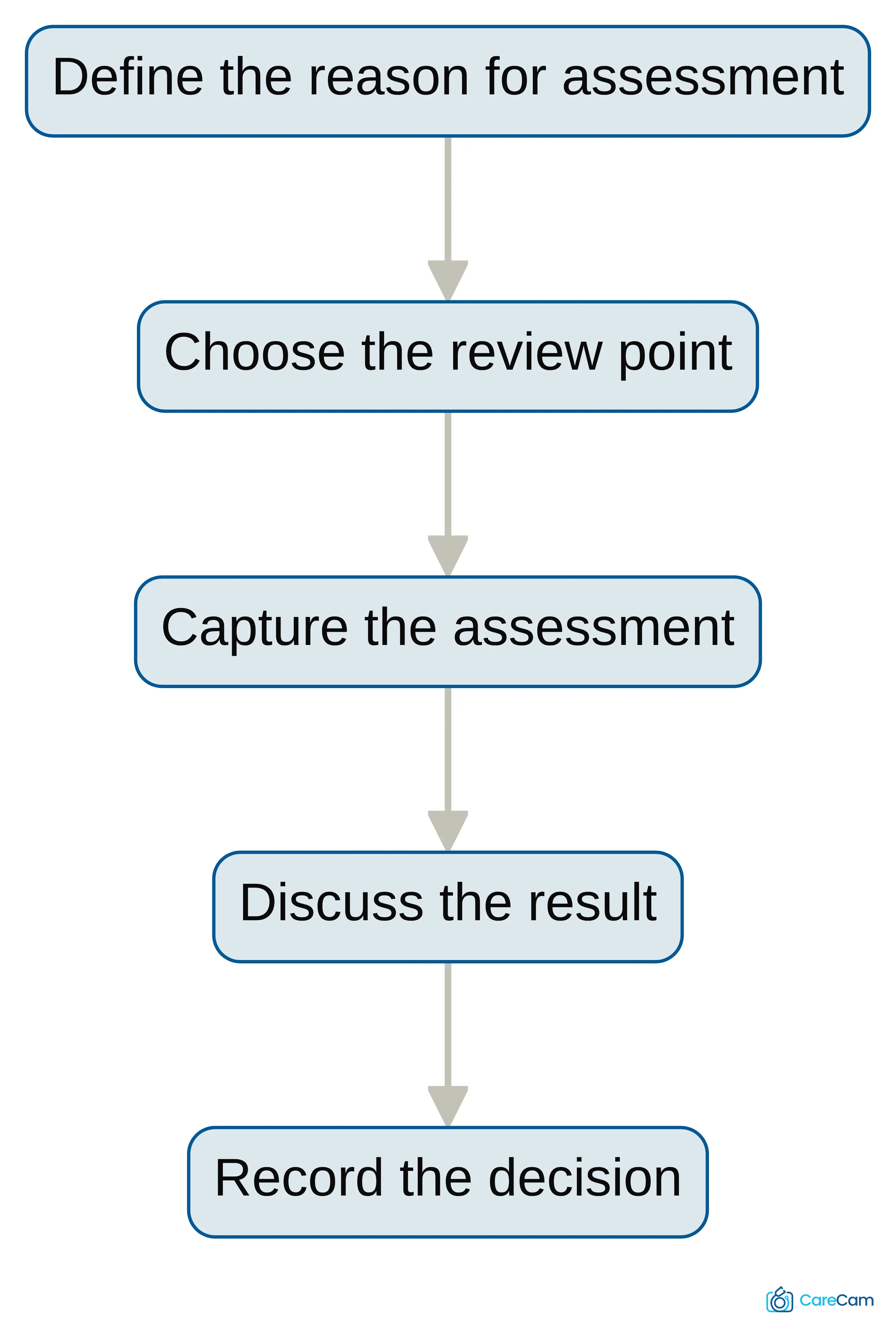
Your organisation can map that process against its existing work:
- Define the reason for assessment. State whether the team is reviewing mobility, fall risk, a change over time, or another approved care question.
- Choose the review point. Decide when the measurement belongs in the pathway and who is responsible for reading the result.
- Capture the assessment. Use the process and conditions accepted by your organisation. Do not assume that every setting or person can be assessed in the same way.
- Discuss the result. Place the measured information beside the wider assessment, observations, recent events, and current care plan.
- Record the decision. Document whether the team maintains, changes, or further reviews the plan through the local process.
We support routine assessments for older adults in primary and community care settings. We also describe 3D gait analysis as designed for routine care. These first-party descriptions give you a starting point for evaluation, not a universal workflow for every Singapore hospital, rehabilitation centre, or aged-care operator.
If your team is evaluating the process in a hospital or residential setting, identify the local pathway that will own the result. If no team or role is responsible for review, the measurement has no clear place in care. If the result is reviewed but cannot influence a documented plan, the organisation should question whether the additional step has a defined purpose.
Do not assume that video analysis saves staff time. Measure the full workflow, including preparation, capture, analysis, review, documentation, and follow-up. Compare that work with the current process and decide whether the information gained justifies the time required.
How can teams use measurements over time?
Care teams can use measurements over time by comparing results at agreed review points and discussing what changed before adjusting care. A later result should prompt interpretation, not an automatic decision.
We help care teams track changes in mobility and function to support timely adjustments to care. Together, these features describe a monitoring pathway: capture, compare, review, and decide.
A useful longitudinal record should answer four questions:
- What was the original care question?
- When was the earlier measurement taken, and under what relevant conditions?
- What changed in the person’s movement or wider situation before the next measurement?
- What did the care team decide after reviewing the comparison?
Normative ranges can provide a reference for objective measurements, but a range is not a diagnosis and does not replace clinical judgment. A difference between visits may reflect a meaningful change, a change in context, or a difference in how the assessment was carried out. Your team needs to interpret the result with the person’s history and current condition.
This matters in rehabilitation and aged-care settings, where teams may want to understand whether mobility or function has changed during an ongoing care plan. The measure can make the change easier to discuss, but it does not establish the cause of the change. In hospital care, the interval between assessments and the reason for repeating them should follow the organisation’s pathway.
Use the comparison to support a review conversation. Record the care decision separately. A measured change can be a reason to look again; it is not, by itself, an order to alter treatment or support.
What does assessment not prove?
A fall-risk assessment does not prove that a fall will occur, that a fall will be prevented, or that a particular intervention will suit a person. This is a direct limit on the way you should frame any assessment technology. A tool can support a prevention process without guaranteeing its result.
In the AHRQ PSNet primer, no existing clinical prediction rule is shown to be significantly more accurate than another for identifying hospital patients at high risk of falls. A numerical result should therefore not become an automatic admission, discharge, staffing, or treatment decision unless your local clinical governance supports that use.
We report a strong correlation between 3DGait biomarkers and gold-standard laboratory measurements. Correlation does not mean that every 3DGait output is a laboratory measurement, a diagnosis, or a complete account of fall risk. Keep the claim at its stated level when you explain the evidence to staff and leaders.
We state that 3DGait remains under clinical study for some modules and uses, including Vis-Frailty. Do not present Vis-Frailty or another module still under study as established clinical practice. Ask which specific function is being evaluated and keep any use within the evidence and governance approved for that function.
Objective measurement also does not remove the need to consider delirium, psychoactive medicines, strength, mobility, balance, the environment, or other factors identified through the wider assessment. It does not replace care-team review. Your organisation should use the result as one input and keep the final clinical decision with the appropriately qualified professional.
What evidence should an organisation examine?
An organisation should examine whether each piece of evidence matches its population, setting, decision, and intended use. A respected source can still answer a different question from the one your Singapore service needs to answer.
Use these distinctions when reviewing material:
- Guidance and local relevance: NICE recommends comprehensive falls assessment and management in hospital inpatient and residential care settings. A separate cited NICE recommendation covers people in community settings who do not need comprehensive falls management but may benefit from specific interventions. These are different pathways, and NICE guidance is not a Singapore clinical protocol.
- Setting: The cited AHRQ sources discuss healthcare settings, including hospital fall prevention. The cited Cochrane discussion describes environmental interventions aimed at home, outdoor, community, and public settings. Match the source setting to your own before applying its implications.
- Assessment versus prevention: Evidence that describes a risk factor or measurement does not automatically show that using the measurement prevents falls. The cited AHRQ PSNet source specifically says prevention remains an ongoing challenge.
- Measurement evidence: We report a strong correlation between 3DGait biomarkers and gold-standard laboratory measurements. Review the exact biomarker, comparison method, population, and intended use before drawing a broader conclusion.
- Product status: We state that some 3DGait modules and clinical uses, including Vis-Frailty, remain under clinical study. Separate established descriptions from functions still being studied.
Your evaluation questions should include: Who was assessed? In which setting? What did the measurement or intervention involve? What outcome was examined? What conditions applied? Who interpreted the result? What decision can the evidence support?
Keep each answer beside the claim it supports. Do not use evidence about a laboratory correlation to support a claim about fall prevention, and do not use community environmental guidance to define an inpatient workflow without a separate justification. The evidence boundary should shape the adoption boundary.
What should an evaluation checklist cover?
An evaluation checklist should connect the organisation’s care question with the measurement, the review process, and the evidence boundary. Our described service adds an objective layer to fall-risk assessment, captures and analyses a short video, compares objective measurements with normative ranges, and tracks them over time.
Use questions such as these:
- Purpose: What specific decision will the fall-risk assessment support in your hospital, rehabilitation centre, or aged-care setting?
- Population: Does the intended use concern older adults, and does the setting match the stated routine-assessment scope?
- Workflow: Where will the short-video assessment occur, who will capture it, and who will review the result?
- Comparison: What will your team compare across visits, and how will it record the context of each comparison?
- Clinical review: Which qualified professional will interpret the result alongside screening questions, timed tests, observations, and the wider assessment?
- Action: What prevention or monitoring decision could follow, and which local protocol governs that decision?
- Evidence: Which specific source supports the proposed use, and does its population and setting match yours?
- Status: Is the function established for the intended use, or does it remain under clinical study?
- Governance: What local requirements apply to the proposed workflow, records, access, and oversight?
- Workload: How much staff time does each step require, and what work would it replace or add?
We support routine assessments for older adults in primary and community care settings, while our 3D gait analysis is described as designed for routine care. Those facts can inform the checklist, but they do not answer the organisation-specific questions about hospital or residential use.
Keep Vis-Frailty and other modules or clinical uses under study in a separate category from established workflow options. Do not combine their evidence when presenting an adoption recommendation. A clear checklist should help leaders see what is known, what remains conditional, and which decision still belongs to the care team.
How should teams test workflow fit before wider use?
Teams should test workflow fit through a limited, clearly defined evaluation before they consider wider use. The test should examine whether the measurement answers a real care question and whether staff can review it within the existing pathway.
Start by writing the intended use in one sentence. For example: your team may want to define who reviews an assessment result and where that review is recorded. Keep the sentence narrow. Do not begin with a general promise about preventing falls or improving outcomes.
Then map the work:
- Identify the existing assessment step that the objective measure will complement.
- Assign responsibility for the assessment and state who receives the result.
- Record the time and staff effort required for the assessment, result review, documentation, and follow-up.
- Place the result beside the usual screening questions, timed tests, observations, and care plan.
- Record whether the team can interpret the result and what decision it makes afterward.
- Gather questions or failure points that require clinical, operational, or governance review.
A workflow test can examine how those stated steps fit your organisation; it should not convert them into a claim about suitability for every setting.
If the assessment produces information but no agreed review action, stop and resolve that gap before expanding the process. If staff can complete the steps but cannot explain what the result means within the care plan, the evidence and training boundary needs attention. If the process adds time, compare that work with the value of the information rather than assuming that automation removes it.
A useful evaluation ends with a documented decision: continue the defined use, change the workflow, limit the use, or do not proceed. The decision should name the evidence and local conditions that support it.
Keep the evaluation record specific enough that another member of the care team can understand what was tested without turning the test into a general claim about the technology. State the care question in terms of the review that the organisation wants to improve. For example, the question may concern who reviews an assessment result, where the result is recorded, and what happens when it does not fit the wider clinical picture. The question should not assume that a measured change explains its own cause or dictates an intervention.
Record the setting and population separately from the care question. A hospital inpatient pathway, a rehabilitation review, and an aged-care process may have different owners, review points, and local requirements. That distinction should remain visible in the evaluation record. NICE guidance is an external reference, not a Singapore protocol, so the organisation must identify the local pathway that governs its use.
Describe what the measurement contributes and what remains outside its role. An objective result can support a review conversation, but it does not replace screening questions, timed tests, observations, environmental review, medicine review, or care-team judgment. It does not establish that a fall will occur or be prevented. These boundaries help the organisation identify an evaluation that is wider than its evidence.
For each comparison, note the original question, the review point, and the relevant context. A difference between visits can reflect a change in movement, a change in the person’s wider situation, or a difference in how the assessment was carried out. The record should therefore preserve the team’s interpretation and decision rather than treating the numerical or measured difference as self-explanatory. If the result and clinical observation do not agree, record that disagreement for professional review instead of resolving it through an automatic rule.
The evidence section should identify the exact proposition being considered. A correlation between 3DGait biomarkers and gold-standard laboratory measurements addresses a measurement relationship; it does not by itself support a claim about preventing falls or selecting treatment. The cited Cochrane discussion concerns environmental interventions aimed at safety in home, outdoor, community, and public settings. Each source should be kept with the narrower question it can inform.
Keep product status visible when the proposed use concerns a module or clinical function. We state that some 3DGait modules and uses, including Vis-Frailty, remain under clinical study. A workflow evaluation should therefore record whether its proposed function is within the established description being considered or belongs in the separate category of uses still under study. The organisation can then limit the evaluation to the defined function instead of allowing a general assessment result to imply wider clinical use.
Finally, record workload and ownership in the same decision note. State who receives the result, who reviews it, who communicates the plan, and where the decision is documented under the local process. Include the staff effort required for the assessment, review, documentation, and follow-up, then compare that work with the question the organisation needed to answer. If no role owns review, or if no care decision can follow the result, the organisation has identified a workflow gap rather than evidence that the measurement is unsuitable. That distinction supports a clearer decision to revise the pathway, narrow the use, continue the defined evaluation, or stop.
What questions should leaders ask about implementation?
Leaders should ask implementation questions that expose ownership, workload, clinical meaning, and evidence limits before approving an objective fall-risk workflow. The questions should lead to a defined operating process, not a general statement that technology will make prevention easier.
Clinical use
- What question is the assessment meant to answer?
- How will the result sit alongside screening questions, timed tests, observations, and local clinical judgment?
- Which findings require a care-team review, and who has authority to make that decision?
- What will the team do when the measured result and clinical observation do not agree?
Setting and population
- Does the intended use match primary or community care, where we state that routine assessments for older adults are supported?
- If the organisation is a hospital, rehabilitation centre, or aged-care operator, what local pathway connects the result to care?
- Which people or situations fall outside the defined use?
Operations
- Who captures the short video?
- Who analyses or receives the result?
- Who reviews it, records the decision, and communicates the plan?
- How much time does each step take, and what existing work changes as a result?
- How will the team compare measurements across visits and record the context of each comparison?
Evidence and status
- Which source supports the exact proposed use?
- Does a correlation between 3DGait biomarkers and laboratory measurements support the decision being considered, or does it answer a narrower measurement question?
- Which modules or clinical uses remain under study, including Vis-Frailty?
- What evidence would cause the organisation to narrow, pause, or end the use?
Governance
- Which Singapore requirements and local protocols apply to the proposed setting?
- Who oversees the workflow and handles exceptions?
- How will the organisation document the purpose, review, and limits of the assessment?
The implementation decision should state what the system contributes, what remains a professional decision, and what the organisation will measure before it expands use.
What should each Singapore care setting decide before using objective movement measurement?
Before an organisation chooses an objective fall-risk measurement, classify the care setting and write down the decision question the result would support. This setting-first review method keeps the discussion tied to the organisation’s existing assessment, prevention plan, and Singapore protocols.
Use four fields for each setting:
- Setting and pathway: identify whether the work concerns hospital inpatient care, residential care, rehabilitation, or community-facing care, and name the local pathway that governs review.
- Care question: state what the team needs to examine, without treating a measurement as an individual diagnosis.
- Current plan: note the existing fall-risk assessment and prevention actions.
- Review point: specify when the care team will consider the result and compare it with other relevant information.
The setting changes the reference point. NICE recommends comprehensive falls assessment and comprehensive falls management in hospital inpatient and residential care settings. Its cited community recommendation covers people who do not need comprehensive falls management but may benefit from specific interventions to reduce fall risk. These distinctions should inform discussion, not replace Singapore protocols or clinical judgment. In a rehabilitation centre, the team should first identify which pathway and care question apply.
If the care question calls for objective movement information, our 3D gait analysis is designed for routine care. The assessment uses a short video and produces objective measurements for review, progress tracking, and care planning. We compare objective measurements with normative ranges and track them over time. Traditional fall-risk assessment combines screening questions with timed tests, which can vary between assessors; the objective layer provides another set of measurements for the team to review.
Those measurements do not establish individual treatment or prove that a fall will be prevented. Review them with factors associated with fall risk, including delirium, psychoactive medicines such as benzodiazepines, and baseline strength, mobility, or balance difficulties. A tailored prevention plan, care-team communication, environmental safety measures, and other interventions still depend on the setting and clinical judgment.
The evidence also has limits. The cited AHRQ PSNet primer reports no significant accuracy advantage among existing clinical prediction rules and says that preventing patient falls remains an ongoing challenge. We report a strong correlation between 3DGait biomarkers and laboratory measurements, while 3DGait remains under clinical study for some modules and clinical uses, including Vis-Frailty.
For an organisational review, complete the four fields for one setting before comparing options across settings. Ask whether the care question, review point, evidence boundary, governance, and workload are clear enough for the organisation’s local process. That produces a setting-specific basis for discussion without treating measurement as a prevention intervention.
Next step
Have a question for CareCam?
Technical and clinical questions go to the team who built 3DGait and Vis-Frailty.
Get in touch