

frailty assessment
What frailty means before and after surgery

What does frailty mean before surgery?
Frailty before surgery means that changes in strength, walking, energy, or other health problems may leave you with less reserve when your body faces an operation. An assessment can help you and your healthcare team discuss those changes, the support you may need, and the questions to address during pre-operative assessment and post-operative recovery.
One model describes it through features such as unintentional weight loss, reduced muscle strength, slower walking, exhaustion, and low energy. Another model looks at an accumulation of symptoms, signs, and diseases. These models give healthcare professionals ways to organise a wider conversation about your health and function.
The useful first step is practical: tell your care team about changes in walking, strength, balance, energy, weight, memory, or day-to-day activities. You can also ask how those changes may affect patient support before and after the procedure.
Our Vis-Frailty tool is being developed as a self-guided screening tool for primary care and community settings. It is intended to support a screening conversation, not to replace the clinical discussion that decides what your surgery and recovery plan should include.
How is frailty different from normal ageing?
The frailty models described by the British Geriatrics Society look at changes in health and function, such as reduced strength, slower gait, exhaustion, weight loss, and accumulated health deficits; they do not describe a person by age alone.
Those details are more relevant to a discussion about support around surgery than a birth date by itself.
You do not need to label yourself as frail before speaking with your team. Instead, describe what has changed and what you can or cannot do now. A caregiver may be able to add details about meals, stairs, bathing, shopping, medicines, or recent falls if you find those changes difficult to remember.
A change in function also deserves attention even when you do not think of yourself as frail. Tell your team whether the change happened gradually or quickly, and whether it affects tasks you could previously manage.
Our Vis-Frailty tool provides an objective frailty score, together with scores for mobility, strength, balance, and fall risk. Those measures describe areas for discussion; they do not turn normal ageing into a diagnosis or establish what treatment you need.
Why can frailty matter around surgery?
Frailty can matter around surgery because the operation is only one part of the experience. Your team may also need to understand how you move, manage other health conditions, think and communicate, take medicines, return home, and manage daily tasks after the procedure. Comprehensive Geriatric Assessment is a clinical management approach that helps a team identify and address relevant issues for an individual patient.
The Centre for Perioperative Care–British Geriatrics Society guidance says patients older than 65 should have a Clinical Frailty Scale score documented during pre-operative assessment. The same guidance says a score of 5 or higher should prompt documented cognitive assessment and Comprehensive Geriatric Assessment. This is United Kingdom guidance cited by the British Geriatrics Society, not a Singapore rule. Use it as a prompt for a question rather than as a local eligibility test.
Mobility, strength, balance, and fall risk can also shape practical planning. They may affect how you move through the home, manage stairs, use equipment, or rely on another person after discharge. They do not, by themselves, determine whether surgery is suitable.
In one audit, 42% of patients with a Clinical Frailty Scale score of 5 or higher were considered unsuitable for surgical options after shared decision-making about risks and benefits. That finding describes the audit group; it does not predict your decision or your outcome. The point is that a documented score may lead to a broader conversation about whether the proposed procedure matches your health, priorities, and available support.
Our 3DGait tool quantifies movement before and after surgery and supports return-to-activity decisions. We describe that tool within movement assessment and rehabilitation, not as a way to decide whether you should have surgery.
What happens during a pre-operative frailty assessment?
A pre-operative assessment may begin with questions about your daily function and a documented Clinical Frailty Scale score. Your team may ask how you walk, manage personal care, prepare food, take medicines, remember information, and cope with other health problems. The purpose is to bring relevant concerns into the care plan before a procedure.
If the Clinical Frailty Scale score is 5 or higher, the Centre for Perioperative Care–British Geriatrics Society guidance says cognitive assessment should be documented and Comprehensive Geriatric Assessment should be performed. Comprehensive Geriatric Assessment is not a quick score alone. It is a clinical management approach that provides a framework for interventions addressing relevant issues for you.
You should not use a number from an online article to decide your own score. Describe your usual function and any recent change, then let the healthcare team decide which assessment is appropriate.
A full Comprehensive Geriatric Assessment may take at least 1.5 hours of professional time for the initial assessment and care planning, with a likely total of 2.5 hours including discussion and documentation, followed by ongoing review. A full multidisciplinary review with geriatrician involvement may not be feasible for everyone with frailty, while a holistic medical review based on its principles can still be useful.
That means the form and length of an assessment can differ. Ask what your team will assess, who will be involved, how the findings will be shared, and which concerns need attention before you leave for surgery.
Our Vis-Frailty tool captures a short video for assessment without requiring calibration, wearables, or a large space.
What can a frailty assessment consider?
An assessment may bring several parts of your health and daily life into one conversation. Depending on your situation, you can ask whether the team will consider:
- Strength and energy: Have you lost muscle strength, felt exhausted, or had less energy for ordinary activities?
- Walking and mobility: Has your walking speed or ability to move around the home changed?
- Balance and falls: Have you fallen, felt unsteady, or changed how you use stairs and outdoor spaces?
- Weight and nutrition: Have you lost weight without intending to, or found eating difficult?
- Other health concerns: Do symptoms, signs, or diseases add to the overall burden on your health?
- Thinking and communication: Should memory, cognition, hearing, mood, or communication be discussed before the procedure?
- Home and social support: Who can help with transport, meals, personal care, exercises, medicines, or follow-up?
The phenotype model describes weight loss, reduced strength, reduced gait speed, exhaustion, and low energy. The cumulative-deficit model includes a wider range of symptoms, signs, and diseases. These are different ways of organising information, not a checklist for you to score yourself.
A score does not describe every part of your health, home situation, or priorities.
What can an assessment tell you—and what can’t it tell you?
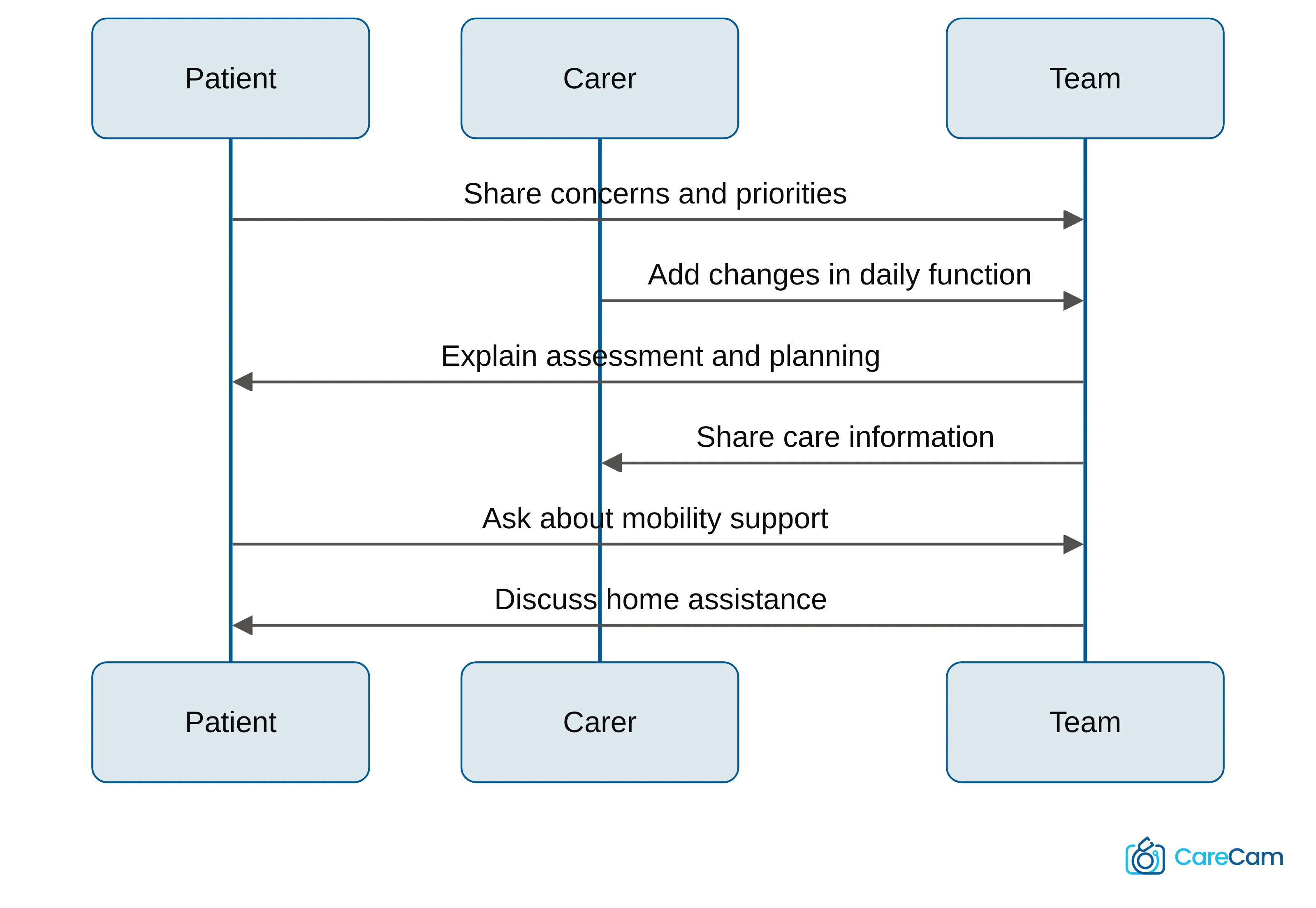
An assessment can help your team identify concerns that deserve attention and agree which questions matter to you. Comprehensive Geriatric Assessment provides a framework for addressing relevant issues for an individual patient. The British Geriatrics Society key messages also call for you, your carers, family, advocates, and healthcare professionals to share decisions, communicate clearly, and work from shared care records.
That can turn a general concern into specific planning questions: Do you need help with mobility? Will someone teach a caregiver how to help? What support is available if you need more assistance at home? Which symptoms or medicines should the team review before the operation?
An assessment cannot establish your surgical eligibility, guarantee a particular recovery, or tell you exactly what will happen after the operation on its own. In the audit cited above, decisions about surgical options followed shared discussion of risks and benefits rather than a score alone. In a digital pathway study, 64 people—8.6% of those assessed—chose not to proceed with planned surgery after Comprehensive Geriatric Assessment and shared decision-making; frailty, multiple health conditions, and cognitive impairment were among the contributing factors. Those results describe those study groups, not your personal situation.
Our Vis-Frailty tool generates a frailty report that highlights people at higher risk and areas to focus on for care. A report can help organise a conversation, but it cannot decide your treatment, replace a clinical examination, or explain every reason for a change in your function.
What support might follow an assessment?
Support after an assessment depends on the concerns your team identifies and on what matters to you. In the digital pathway study, referrals included exercise and wellbeing programmes, physiotherapy, falls services, memory clinics, dietetics, community therapy, and specialist medical services. A full multidisciplinary review may not be feasible for everyone, but a holistic medical review based on Comprehensive Geriatric Assessment principles can still be useful.
You can ask which service fits the concern being discussed rather than assuming every referral applies to you. For example, a change in walking may lead to a discussion about physiotherapy or falls support, while memory, nutrition, continence, or medicines may need different professionals. These are planning possibilities, not a promise that a particular service will be offered.
Before discharge, ask who will help with the tasks you cannot manage alone and how that plan will be communicated to your caregiver. A clear handoff can make it easier to know which team to contact when your needs change.
For stroke rehabilitation, Singapore HealthHub says planning considers current mobility and social circumstances and is decided by the care team together with you and your family. It also says caregivers may need training depending on your care needs. If neurological rehabilitation is relevant to your operation or health condition, ask how the team will assess your movement, home situation, caregiver role, and follow-up needs.
If your procedure involves bones, joints, or movement, ask whether orthopaedic care and rehabilitation services should be part of the plan. The team can connect that question to your procedure and current function rather than relying on a general frailty label.
Our 3DGait tool is for clinicians, allied health professionals, and researchers involved in movement assessment, gait analysis, and rehabilitation. It quantifies movement before and after surgery and supports return-to-activity decisions, while some modules and clinical uses remain under clinical study.
What questions should patients and caregivers ask?
Bring questions that connect the assessment to your daily life. The British Geriatrics Society key messages support shared decisions, clear communication, and shared care records. Singapore HealthHub also describes rehabilitation planning as a decision involving the care team, you, and your family.
You could ask:
- About assessment: Should my pre-operative assessment include a Clinical Frailty Scale score or another review of function?
- About changes: Which changes in strength, walking, balance, energy, weight, memory, or daily tasks should I report?
- About falls: Do I need a fall risk assessment, and what will the result change in my care plan?
- About recovery: What support might I need with walking, bathing, meals, medicines, transport, or other daily tasks after surgery?
- About rehabilitation: Would physiotherapy, neurological rehabilitation, or another rehabilitation service be relevant to my condition?
- About orthopaedic care: If my procedure involves bones, joints, or movement, who will coordinate orthopaedic care and rehabilitation?
- About caregivers: Will someone explain the plan to my caregiver, and could caregiver training be needed?
- About follow-up: Who will follow up with me, what will be reviewed, and how should my family share changes in my function?
- About shared records: Where will the plan be recorded, and which members of the care team can see it?
Write down the answers and the names of services involved. If a caregiver joins the appointment, ask that person to describe changes you may not notice yourself.
You can also ask what would trigger a call to the team after you return home. That may clarify which change is expected during recovery and which change needs prompt advice.
Our Vis-Frailty tool provides scores for mobility, strength, balance, and fall risk, and its report highlights areas to focus on for care. If you are discussing objective measurement with a provider, ask what a score would add to your care conversation and who would interpret it.
How might objective measurement fit into care?
3DGait is intended for clinicians, allied health professionals, and researchers involved in movement assessment, gait analysis, and rehabilitation. Some 3DGait modules and clinical uses, including Vis-Frailty, are still undergoing clinical study.
That distinction matters. A measurement can describe movement or highlight an area for discussion, while the care team still needs your history, examination, goals, health conditions, and home circumstances to interpret it.
If a provider discusses one of these tools, ask three direct questions:
- What part of my care will this measurement inform?
- Who will interpret the result with my other clinical information?
- What decision, conversation, or follow-up would change because of it?
Those questions keep objective measurement connected to patient support rather than treating a number as the whole picture.
What are the limits of these tools?
The main limit is scope.
A screening result or movement measure does not, by itself, establish a diagnosis, determine surgical eligibility, select treatment, predict your personal recovery, or set your follow-up schedule. It also cannot describe every factor that may matter, such as your priorities, other illnesses, medicines, cognition, home layout, caregiver availability, or social circumstances.
Use a tool result as a prompt for a care conversation. Ask the team to explain what the result measures, what it leaves out, and how it fits with the wider plan. For rehabilitation planning, Singapore HealthHub describes consideration of mobility and social circumstances alongside discussion with you and your family. That wider context remains necessary when a tool focuses on movement or frailty-related measures.
When should you seek individual advice?
Seek individual advice from your healthcare team when you are scheduling surgery, notice a change in strength or walking, have fallen, are losing weight without intending to, feel more exhausted, or are unsure what help you will need at home. Bring a caregiver if possible, and ask for a clear plan covering assessment, patient support, rehabilitation, and follow-up.
A frailty assessment is a starting point for shared planning, not a decision you should make alone. A qualified healthcare professional should decide your individual suitability, treatment, and care plan using your full clinical situation. Our Vis-Frailty tool is in a clinical study as of 26 October 2026, so it should be discussed within that wider professional assessment rather than used as a substitute for it.
What should I ask my healthcare team about frailty before surgery?
What is frailty and how does it relate to surgery?
Frailty refers to a decline in strength, energy, and overall health that can affect recovery from surgery. It is assessed through various models that consider factors like weight loss, muscle strength, and mobility. Understanding frailty helps healthcare teams plan appropriate support before and after surgery.
How can I prepare for a frailty assessment before surgery?
To prepare for a frailty assessment, consider discussing any changes in your strength, walking ability, balance, and daily activities with your healthcare team. Be ready to provide details about your health and any concerns you have regarding your recovery.
What should I expect during a pre-operative frailty assessment?
During a pre-operative frailty assessment, your healthcare team will ask about your daily function, mobility, and any health concerns. They may use a Clinical Frailty Scale score to guide further assessments, especially if your score indicates higher frailty.
What questions should I ask my healthcare team about frailty and surgery?
You can ask about the relevance of your frailty assessment, what support you might need after surgery, and how your mobility and strength will be monitored. Inquire about rehabilitation services and how your care plan will be communicated to your caregivers.
What support might I need after a frailty assessment?
Support after a frailty assessment may include referrals to physiotherapy, exercise programs, or other health services based on identified needs. Discuss with your team what specific support will be available to you after surgery.
When should I seek individualized advice from a healthcare professional?
You should seek individualized advice if you notice changes in your strength, mobility, or overall health, or if you have concerns about your recovery needs. A healthcare professional can provide tailored guidance based on your specific situation.
What limitations exist regarding frailty assessments?
Frailty assessments cannot determine surgical eligibility or guarantee recovery outcomes on their own. They serve as a starting point for discussions about care and support, but individual clinical judgment is necessary for treatment decisions.
Next step
Have a question for CareCam?
Technical and clinical questions go to the team who built 3DGait and Vis-Frailty.
Get in touch