

post operative care
What does post-operative care include?

What does post-operative care include?
Post-operative care includes immediate recovery after surgery, discharge follow-up, practical support, and continued communication with your healthcare team. It is connected to the assessment and education you receive before surgery, because information needs to move with you through each part of your care journey.
Perioperative care may include pre-operative assessment, education and counselling, care during the operation, immediate post-operative recovery, and follow-up after discharge. The exact responsibilities vary by setting. Continuity of care links the different parts of your healthcare journey, while missed, outdated, or incorrect information can contribute to inadequate care or errors.
Our role is to add structured information for the care team where our solutions are used. We generate a structured report that builds on previous assessments and provides targeted, longitudinal insights into your progress. That report is one part of care planning; it does not replace the conversations, examinations, instructions, or decisions provided by your surgical and healthcare team.
For you and your caregiver, the practical focus is simple: understand the plan before discharge, know who to contact, arrange the support you will need at home, and keep follow-up connected to the original surgical plan.
Why should planning start before surgery?
Pre-operative planning gives you time to understand the next stages of care and prepare yourself and your home before admission. Perioperative care may include assessment, education and counselling before surgery, and a total-hip-replacement rehabilitation guide also advises preparing yourself and your home before going to hospital.
The details depend on your procedure and health needs. Your surgical team should explain which instructions apply to you, what support may be needed after discharge, and how follow-up will be arranged. Do not assume that advice for one operation applies to another.
Patient support is easier to arrange when you discuss it before the operation. The WHO patient-safety action plan calls for patients and families to have opportunities to contribute to efforts that improve patient safety. You can use that opportunity to prepare a short list of questions, such as:
- What should I arrange at home before admission?
- Which parts of recovery may require help from a caregiver?
- What written instructions will I take home?
- Who should I contact if I am unsure about a change after discharge?
- How will information from the hospital reach the next care team?
Our 3DGait service can quantify movement before and after surgery and support return-to-activity decisions. If your care team uses it, ask what the assessment is intended to measure and how the result will fit into your wider plan. A measurement can inform a discussion; it does not set your activity level on its own.
What should patients and caregivers ask before discharge?
Before discharge, ask for clear written instructions that match your operation and your home situation. SingHealth provides discharge information intended to help you care for yourself while recovering at home, and its spine-surgery page provides preparation and post-surgery information while stating that the information is not intended as medical advice.
Use your own discharge instructions as the working plan. If anything is unclear, ask before leaving rather than trying to fill the gap from general information online.
A short discharge checklist can help you and your caregiver leave with the same understanding:
- What is the next planned contact or follow-up, and who will arrange it?
- Which activities are allowed, limited, or specifically instructed for your operation?
- What care should you provide at home, and what should your caregiver help with?
- Which changes should prompt a call to the surgical or healthcare team?
- Who is the correct contact outside normal appointment times?
- What information should be shared with your family doctor, therapist, community team, or other service?
Write down the answers in the same place as your discharge documents. Ask the team to explain unfamiliar terms in plain language.
Our structured reports build on previous assessments and provide targeted, longitudinal insights into progress. If a report is part of your care pathway, ask how it will be discussed with you and which team member can explain its meaning. You should know whether a result is being used to support a clinical conversation, plan follow-up, or track a selected measure over time.
How does discharge planning connect hospital care with home recovery?
Discharge planning connects the hospital plan with the care you receive at home and in the community. Continuity of care depends on connected parts of the healthcare system, and missed, outdated, or incorrect information can contribute to inadequate care or errors.
You can support that connection by keeping your discharge papers together, sharing the instructions with your caregiver, and telling the next team what has changed since discharge. Bring a written list of questions to follow-up appointments. These simple steps help keep your own account of the plan alongside the formal clinical record.
If you are older and living with frailty or dementia, discharge planning may need to start as soon as possible after admission. British Geriatrics Society guidance recommends this approach and uses a “Home First” principle. The same guidance recommends recuperative rehabilitation in hospital wards and linked community services.
That guidance does not create one discharge plan for every person. Ask your team which services will be involved, who will coordinate the handover, and what support is available once you return home.
We help care teams track progress and plan care from hospitals to the community. Where our solutions are used, that information can sit alongside the handover and follow-up arrangements made by your healthcare team. It is not a substitute for a discharge plan or for direct communication between the professionals caring for you.
What support may be relevant during recovery?
Patient support may include help from family, caregivers, hospital staff, community services, and other professionals involved in your recovery. The WHO patient-safety action plan supports giving patients and families opportunities to contribute to patient-safety efforts. British Geriatrics Society guidance also describes frailty-attuned care as coordination across primary, hospital, community, social, and mental-health services.
Your support plan should reflect what you can manage at home and what your care team has instructed. Tell the team if the planned help is not available, if responsibilities are unclear, or if you are struggling to follow the agreed plan.
A frailty assessment may be relevant when you are older or have concerns about strength, mobility, balance, or the support needed after discharge. British Geriatrics Society guidance recommends systematically identifying frailty in all settings with the Clinical Frailty Scale. For orthopaedic care, use the instructions for your specific operation; spine-surgery and hip-replacement resources show why procedure-specific preparation and rehabilitation guidance matters.
If your recovery involves neurological rehabilitation or another specialist service, ask your surgical team which professionals should be involved and how their advice fits together. General information cannot set that plan for you.
We generate a Vis-Frailty report that highlights people at higher risk and areas to focus on for care. We also provide an objective frailty score, along with scores for mobility, strength, balance, and fall risk, through Vis-Frailty.
These reports are intended as information for care teams. Ask what a score means in your situation, what other information will be considered, and who will explain any resulting care plan.
How can recovery be monitored over time?
Recovery monitoring brings together follow-up, your account of changes, and information collected by the professionals involved in your care. Perioperative care may include follow-up after discharge, while continuity of care depends on information moving between connected parts of the healthcare system.
Your own record can stay practical. Keep your discharge instructions available, note questions as they arise, and take those questions to the team that is responsible for your recovery. Do not create a personal schedule for appointments, activity, or treatment unless your healthcare team gives you one.
Our 3DGait service establishes a baseline and tracks progress over time. We allow users to compare selected 3DGait measurements across assessments. If your care team uses this approach, ask which measurement is being compared, what period it covers, and how the comparison will inform the next clinical discussion.
A change in a measurement is a piece of information, not a prediction of how your recovery will end. Your team still needs to consider your symptoms, examination, procedure, instructions, and wider health needs.
Our structured report builds on previous assessments and provides targeted, longitudinal insights into patient progress. That format can help a care team look at information across more than one assessment instead of treating each result as an isolated event. Ask for an explanation of any result you do not understand.
What can objective recovery measures add?
Objective recovery measures add recorded information that can be compared with earlier assessments. We capture a person walking, analyse the movement on the device, and generate a report and visualisations for clinicians and researchers. We measure angular joint angles, spatial distances, and temporal speed and timing during the gait cycle.
In plain language, these measures describe aspects of how you move during the captured task. They do not describe every part of your recovery, and they should be read alongside your clinical assessment and your own account of how you are managing.
Our 3DGait service can be used to quantify movement before and after surgery, establish a baseline, compare selected measurements over time, and support return-to-activity decisions. The practical questions for you are:
- What movement is being measured?
- Is this the first assessment or a comparison with an earlier one?
- Who will interpret the result?
- How will the result fit with the instructions for your operation?
The final question matters because a measurement can support a decision without making the decision.
Our Vis-Frailty service provides an objective frailty score together with scores for mobility, strength, balance, and fall risk. A care team may use that information to identify areas to focus on, but the score should be discussed with the professionals responsible for your care. It is not a diagnosis or a complete description of your needs.
What can’t monitoring tell you by itself?
A recovery measurement cannot decide your individual treatment, activity level, or suitability for a particular step by itself. Our 3DGait service supports return-to-activity decisions, but support is different from making the decision. We also state that 3DGait is still undergoing clinical study for some modules and clinical uses, including Vis-Frailty.
Use monitoring results as part of a conversation with your surgical or healthcare team. Ask what the result means, what it does not measure, and whether it changes any part of the plan you were given.
A report cannot replace your discharge instructions, a clinical assessment, or communication between the professionals involved in your care. SingHealth provides preparation and post-surgery information for spine surgery while stating that the information is not intended as medical advice. Continuity also depends on accurate information being shared across the healthcare journey.
If a result seems different from how you feel, or if it does not match the instructions you received, raise that difference with your care team. Do not change your plan based on a score alone.
When should you contact your care team?
Your discharge instructions should tell you when to contact your surgical or healthcare team. SingHealth’s discharge information is intended to help you care for yourself during recovery at home, and its spine-surgery information provides post-surgery guidance while stating that it is not intended as medical advice.
Contact the team using the route in your instructions when:
- the instructions tell you to report a change;
- you are unsure whether a new or worsening change needs review;
- you cannot follow an important part of the agreed plan;
- the support arranged for home recovery is no longer available; or
- you do not know who is responsible for the next follow-up.
Keep the contact details with your discharge documents. If your instructions give a different escalation route, follow that route.
We generate a structured report that builds on previous assessments and provides targeted, longitudinal insights into patient progress. That information can support a follow-up conversation where our solutions are part of your care pathway, but it is not a replacement for contacting the team responsible for a new concern.
How can you prepare for a supported recovery?
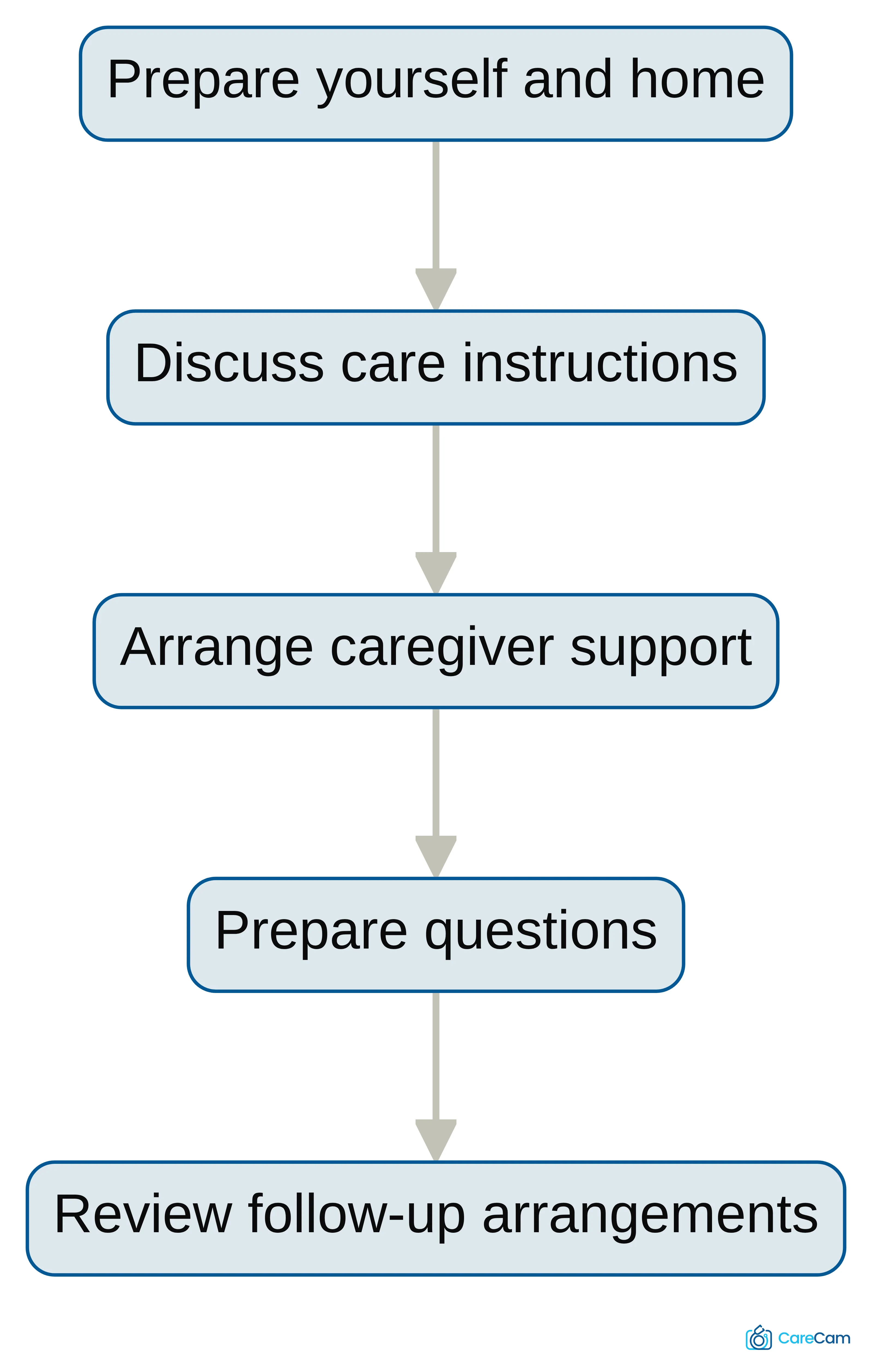
A supported recovery starts with a connected plan: prepare before admission, understand the discharge instructions, arrange patient support, and keep follow-up linked to the team caring for you. Preparing yourself and your home before hospital admission is advised in a total-hip-replacement rehabilitation guide, while perioperative care may include education before surgery and follow-up after discharge.
Before surgery, write down your questions and identify who can help at home. Before discharge, confirm the instructions, contacts, and next planned communication. During recovery, keep your care team informed when the instructions tell you to report a change or when you are unsure what to do next.
We offer solutions that can fit into clinical workflows. Our 3DGait service can establish a baseline, compare selected movement measurements over time, and support return-to-activity decisions, while clinical professionals remain responsible for interpreting the information and deciding what applies to you.
A qualified healthcare professional should decide whether any assessment, monitoring approach, or recovery plan is suitable for your circumstances. Use general information to prepare questions, then follow the instructions given by your own surgical and healthcare team.
What should you confirm with your care team before going home?
What questions should I ask before discharge?
Before discharge, ask for clear written instructions tailored to your situation. Inquire about follow-up appointments, activity restrictions, care requirements at home, and who to contact if you have concerns.
How can I monitor my recovery after surgery?
Monitoring your recovery involves keeping track of your symptoms and following up with your healthcare team. You can also ask about any objective measures, like movement assessments, that may be part of your care plan.
When should I contact my healthcare team after surgery?
You should contact your healthcare team if you notice any changes that concern you, if you cannot follow the discharge instructions, or if the support you arranged is no longer available.
What role does patient support play during recovery?
Patient support can include help from family, caregivers, and community services. It’s important to communicate your needs and any changes in your situation to ensure you receive the appropriate support.
Next step
Have a question for CareCam?
Technical and clinical questions go to the team who built 3DGait and Vis-Frailty.
Get in touch